Marketers are a strange bunch, there's no getting around it. I bet they all live in some alternate universe, a shadowy place lit only by billboards displaying TV drug commercials. In that world, teeming hordes of consumers mill about, searching for guidance or at least a kick-ass pair of jeans.
Such a scenario is the only way to explain Turner Broadcasting's latest campaign to promote a Cartoon Network show. The company's marketing department was apparently convinced that people would squeal happily at the sight of small, blinking devices attached to a bridge and immediately shout "Aqua Teen Hunger Force!" Uh, sure.
What happened, of course, was that Boston police thought they were bombs and blew them up. I tell you, if my personal safety from terrorists ever becomes a major concern, I'm moving to Boston. It was the only major city hit by the campaign to respond. Apparently terrorists could install blinking lights spelling out "KABOOM" in every major bridge in New York and San Francisco and no one would care.
Marketers say they're driven to such crazy stunts because consumers are so sophisticated. They need to cut through the blizzard of ads surrounding consumers (and who is responsible for that blizzard?) and trigger an immediate emotional response. Quality doesn't sell. Truth doesn't sell. Common sense doesn't sell. Apparently even words don't sell, since marketers are paring their message down to a blinking cartoon character on a bridge giving us the finger.
Which brings us, oddly enough, to the Detroit Metro Convention and Visitors Bureau, which is always dreaming up new ways to attract tourism. They've given up on silly slogans ("It's a Great Time in Detroit!") and reduced this gritty, struggling city to a single letter: D. I suppose that's better than campaign's official underlying message -- a stealth slogan, if you will -- which is "Detroit: Where Cool Comes From." Congratulations, DMCVB, you've found a slogan so stupid that even you won't use it on your marketing material.
The Detroit Free Press lapped up the whole concept, opening a fawning Feb. 1 article on the campaign with: "Whatever happens in Vegas can stay there. This is the D." Then the editors presented a montage of D's through history. Jesus, is this a reputable newspaper or Sesame Street? Will E be the letter of the day today?
Maybe I just don't get it. The convention bureau says it's targeting young people ages 21-34, those too young to remember the 67 riots or Detroit's bleak winter of 1981. (For a really good history of Detroit during the 70s and 80s, the era the convention bureau apparently wants to sweep under the rug, read David Halberstam's "The Reckoning." It remains one of my very favorite books.)
Anyway, the convention bureau doesn't want cranky folks like me. They want the young, hip, grungy crowd. Maybe they're right, but I can't imaging edgy, disaffected 20-somethings sitting around saying, "Detroit could be a cool place -- if only it had some fancy metal Ds on its marketing literature."
Oh hell, maybe Detroit's marketers are right and I am wrong. In fact, maybe even a D is too complicated -- too old-fashioned and cerebral. Maybe the convention bureau should put some blinking guy on the RenCen, giving everyone the finger.
Friday, February 02, 2007

Thursday, January 25, 2007
Home Repair Hell
Well, thank god we’re almost through January, which at our house has become The Month of Home Repair. Those last two words always make me want to lie down in a darkened room -- now a viable option since our handyman has fixed the bedroom’s broken window.
I suppose I shouldn’t complain (not that it’s ever stopped me before), since we’ve lived in this house for nearly four years without a home repair bill. Are we lucky or just slothful? I suspect the latter. I mean, I broke that bedroom window a year ago while trying to jam an ill-fitting shade into its bracket (socket? docket? moppet?). So yeah, we haven’t paid any home repair bills before this month, preferring to live with broken windows, sticky doors and cracked caulking.
But now we’ve decided to sell said house, since Ron’s daily commute to Oakland County has given him nervous twitches and a predilection for weird audio books. (“Who will you meet in Heaven?”) Plus Benny refuses to add the Daddy when he plays with his stuffed sheep family because “the Daddy’s at work.” It’s just a difficult situation.
So we’re selling the homestead during what the Detroit Free Press calls a “perfect storm” of economic misery. The National Association of Realtors, the Free Press continues, said last year that Metro Detroit had suffered the sharpest decline in home values in any large urban market in the nation.
So we’re really excited, as you might imagine. Determined to wring every last drop of blood from this stone, we’re doing home repairs, walking that fine line between adding value to the house and just throwing money down the drain (or the basement, to be precise).
The phrase “doing home repairs” is, of course, terribly misleading. You might imagine me or Ron replacing hinges or popping off old tiles. Actually the real process is less impressive. I make a list of the most necessary jobs: fix windows, recaulk bathtub, deal with basement (affectionately nicknamed “The Evil Dungeon of Cat Hairballs).
Then I whine about the list for weeks, frequently lying down on the bed and glaring at the broken window. Then I reluctantly call a handyman recommended by a local hardware store. His line is busy. I lie down again, exhausted by my efforts. But Barry the Handyman calls me back (curse that caller ID!) and I reluctantly admit I have some jobs for him and try not to groan when he says he’s free this week.
Barry shows up with his son and they’re unfailingly kind and patient with my sorry self. I feel humiliated, pointing out all the problems I’ve ignored for years, but I rally until we come to the bathroom electric outlet.
The outlet is itself is fine, but the cover isn’t screwed on. The house’s previous owner (who frankly had more do-it-yourself spirit then was good for a man) had updated the outlet per our home inspector’s recommendation, but didn’t have time to attach the cover.
“No trouble, I said blithely then. “We’ll get that screwed on this weekend.”
Ahem. Well, three and a half years later, and the cover still hangs there, fastened only by a round nightlight. Barry looks at me blankly, then instructs his son to screw the cover on – no extra charge. Barry Jr. does it in two minutes.
After that harrowing experience, I was ready to abandon all home repair efforts and tell prospective buyers the house had “lots of character.” But then our water heater busted, leaking all over the basement carpet. (Why do you always discover these things at 11:45 p.m.?)
So I only had eight hours to whine before calling Barry again. He bought us a new water heater, installed it, took the old one away and advised me to call our insurance agent. Maybe they can clean up the water damage. “Who’s your insurer?” he asked.
I had no clue. This is another reason why home repair is so stressful. I’m just ignorant. I don’t know how old my water heater is, I don’t know when we last replaced our furnace filter, I don’t know the square footage of our basement, I don’t know whether our electricity operates off fuses or circuit breakers (although I did guess right on the last).
I did find our homeowners’ policy, but our deductible was too large to save any money. Which left me and Barry and Barry Jr. staring at the basement carpet, unequivocally damp and smelling faintly of mold. It had to go.
So I sent them away, lay down in a darkened room (admiring my unbroken window), then consulted Ron, who frothed at the mouth at the idea of paying the Barrys to rip up the carpet. “I can do that!” he cried over the phone.
“Oh yeah?” I asked. “But we don’t know what’s underneath. You want to rip out rotted subfloor?” I painted dire pictures of putrid sinkholes and nests of trolls living under our basement carpet, then promised to write some articles to pay for the work.
“But you have to be there when they start ripping it up,” I said.
Ron agreed. We finished shoveling out the basement Tuesday night. Ron dropped the kid off at daycare yesterday morning while I put our cat in Benny’s bedroom and our dirty laundry in the home office. Then Ron and I lined up wide-eyed on the basement stairs for the ceremonial First Cut.
We got off easy. The carpet wasn’t even glued down. The only thing underneath was concrete and some old tile. Ron fled to the safety of work and I hid in Benny’s bedroom with my laptop and the cat while the Barry’s hauled out carpet and tile and mopped the concrete.
So now we’ve come to the end of this episode of home repair. We’ll have to cover that concrete somehow, but we’ve run out of momentum … and money. The basement will have to wait until March. For now, I think I’ll go lie down in a darkened room. Or maybe not. The vent cover on the floor looks like it might need replacing.
I suppose I shouldn’t complain (not that it’s ever stopped me before), since we’ve lived in this house for nearly four years without a home repair bill. Are we lucky or just slothful? I suspect the latter. I mean, I broke that bedroom window a year ago while trying to jam an ill-fitting shade into its bracket (socket? docket? moppet?). So yeah, we haven’t paid any home repair bills before this month, preferring to live with broken windows, sticky doors and cracked caulking.
But now we’ve decided to sell said house, since Ron’s daily commute to Oakland County has given him nervous twitches and a predilection for weird audio books. (“Who will you meet in Heaven?”) Plus Benny refuses to add the Daddy when he plays with his stuffed sheep family because “the Daddy’s at work.” It’s just a difficult situation.
So we’re selling the homestead during what the Detroit Free Press calls a “perfect storm” of economic misery. The National Association of Realtors, the Free Press continues, said last year that Metro Detroit had suffered the sharpest decline in home values in any large urban market in the nation.
So we’re really excited, as you might imagine. Determined to wring every last drop of blood from this stone, we’re doing home repairs, walking that fine line between adding value to the house and just throwing money down the drain (or the basement, to be precise).
The phrase “doing home repairs” is, of course, terribly misleading. You might imagine me or Ron replacing hinges or popping off old tiles. Actually the real process is less impressive. I make a list of the most necessary jobs: fix windows, recaulk bathtub, deal with basement (affectionately nicknamed “The Evil Dungeon of Cat Hairballs).
Then I whine about the list for weeks, frequently lying down on the bed and glaring at the broken window. Then I reluctantly call a handyman recommended by a local hardware store. His line is busy. I lie down again, exhausted by my efforts. But Barry the Handyman calls me back (curse that caller ID!) and I reluctantly admit I have some jobs for him and try not to groan when he says he’s free this week.
Barry shows up with his son and they’re unfailingly kind and patient with my sorry self. I feel humiliated, pointing out all the problems I’ve ignored for years, but I rally until we come to the bathroom electric outlet.
The outlet is itself is fine, but the cover isn’t screwed on. The house’s previous owner (who frankly had more do-it-yourself spirit then was good for a man) had updated the outlet per our home inspector’s recommendation, but didn’t have time to attach the cover.
“No trouble, I said blithely then. “We’ll get that screwed on this weekend.”
Ahem. Well, three and a half years later, and the cover still hangs there, fastened only by a round nightlight. Barry looks at me blankly, then instructs his son to screw the cover on – no extra charge. Barry Jr. does it in two minutes.
After that harrowing experience, I was ready to abandon all home repair efforts and tell prospective buyers the house had “lots of character.” But then our water heater busted, leaking all over the basement carpet. (Why do you always discover these things at 11:45 p.m.?)
So I only had eight hours to whine before calling Barry again. He bought us a new water heater, installed it, took the old one away and advised me to call our insurance agent. Maybe they can clean up the water damage. “Who’s your insurer?” he asked.
I had no clue. This is another reason why home repair is so stressful. I’m just ignorant. I don’t know how old my water heater is, I don’t know when we last replaced our furnace filter, I don’t know the square footage of our basement, I don’t know whether our electricity operates off fuses or circuit breakers (although I did guess right on the last).
I did find our homeowners’ policy, but our deductible was too large to save any money. Which left me and Barry and Barry Jr. staring at the basement carpet, unequivocally damp and smelling faintly of mold. It had to go.
So I sent them away, lay down in a darkened room (admiring my unbroken window), then consulted Ron, who frothed at the mouth at the idea of paying the Barrys to rip up the carpet. “I can do that!” he cried over the phone.
“Oh yeah?” I asked. “But we don’t know what’s underneath. You want to rip out rotted subfloor?” I painted dire pictures of putrid sinkholes and nests of trolls living under our basement carpet, then promised to write some articles to pay for the work.
“But you have to be there when they start ripping it up,” I said.
Ron agreed. We finished shoveling out the basement Tuesday night. Ron dropped the kid off at daycare yesterday morning while I put our cat in Benny’s bedroom and our dirty laundry in the home office. Then Ron and I lined up wide-eyed on the basement stairs for the ceremonial First Cut.
We got off easy. The carpet wasn’t even glued down. The only thing underneath was concrete and some old tile. Ron fled to the safety of work and I hid in Benny’s bedroom with my laptop and the cat while the Barry’s hauled out carpet and tile and mopped the concrete.
So now we’ve come to the end of this episode of home repair. We’ll have to cover that concrete somehow, but we’ve run out of momentum … and money. The basement will have to wait until March. For now, I think I’ll go lie down in a darkened room. Or maybe not. The vent cover on the floor looks like it might need replacing.
Thursday, December 07, 2006
Killer Assassin Robots Ride Off into Sunset
Well, I did it. For the third time I’ve typed the words “THE END” to my science fiction novel (current title: “Are You Still Working on That Thing?”)
This is the third complete draft of the blasted story. The first draft was 50,000 words, written in one month for National Novel Writing Month in 2002. The second draft, completed the following year, cut 10,000 words and added another 30,000, bringing the grand total to 70,000 words. Then I ignored the thing for three years.
Now I’ve finished the third draft, with a total of 87,000 words. It’s kind of frightening, really, to produce nearly 90,000 words of something that may never be useful to anyone. I’ve been plugging along since January, constantly grumbling, occasionally excited and generally discouraged. In August, when I realized that the 25,000-word chunk I’d written about Jupiter was gonna have to go (a science fiction novel, remember), I nearly gave up.
But I soldiered on, confining my outside reading to history books so I wouldn’t sound like Richard Russo or Jane Austen or Anne Tyler. I was, however, imprudent enough to watch the first season of “24” on DVD, so my new Jupiter chapters are really short with lots and lots of shooting.
So is it any good? Well, I’d be the last one to know. I can’t bear to look at the thing. I wrote the novel’s climax yesterday at some humdrum library next door to a senior rest home. (Writers always tell you to write in boring places; don’t distract yourself with a lovely view. In that respect, the Pittsfield Township Library was perfect.) Anyway, writing the final chapters took three hours. I finally left to pick Benny up from daycare, sporting a glazed expression and a splitting headache.
Today I wrote a tiny epilogue (320 words) to wrap everything up. I flirted with all kinds of fun little moments, then resorted to the old “guy wakes up in hospital bed” bit. And while there isn’t a wedding (the experts say a novel should end with a wedding, celebration or funeral), there is a proposal – of sorts.
So what have I learned in my year of revising? Well, I learned how to write fiction when I ‘d rather do anything else. I learned to write fiction while tired, while sick, while my kid is whining, while the guy next to me in the coffee shop yaks loudly on his cell phone (“Did you get my email? I sent it 10 minutes ago. Let me tell you what it said …”)
I’ve learned to write pages and pages of dreck, realize it’s dreck and cut it all, then decide it’s not dreck and put it back, then go back and change previous chapters to support the dreck … You get the idea.
I also learned that killer assassin robots can fill a multitude of plot holes. Think of them as literary spackle.
Meanwhile, I’m excited at the prospect of having a life again. Benny will be baptized on Sunday, with friends and family standing by. Christmas is coming, and my more conscientious relatives are demanding gift lists. And finally, in January comes the next season of “24.”
This is the third complete draft of the blasted story. The first draft was 50,000 words, written in one month for National Novel Writing Month in 2002. The second draft, completed the following year, cut 10,000 words and added another 30,000, bringing the grand total to 70,000 words. Then I ignored the thing for three years.
Now I’ve finished the third draft, with a total of 87,000 words. It’s kind of frightening, really, to produce nearly 90,000 words of something that may never be useful to anyone. I’ve been plugging along since January, constantly grumbling, occasionally excited and generally discouraged. In August, when I realized that the 25,000-word chunk I’d written about Jupiter was gonna have to go (a science fiction novel, remember), I nearly gave up.
But I soldiered on, confining my outside reading to history books so I wouldn’t sound like Richard Russo or Jane Austen or Anne Tyler. I was, however, imprudent enough to watch the first season of “24” on DVD, so my new Jupiter chapters are really short with lots and lots of shooting.
So is it any good? Well, I’d be the last one to know. I can’t bear to look at the thing. I wrote the novel’s climax yesterday at some humdrum library next door to a senior rest home. (Writers always tell you to write in boring places; don’t distract yourself with a lovely view. In that respect, the Pittsfield Township Library was perfect.) Anyway, writing the final chapters took three hours. I finally left to pick Benny up from daycare, sporting a glazed expression and a splitting headache.
Today I wrote a tiny epilogue (320 words) to wrap everything up. I flirted with all kinds of fun little moments, then resorted to the old “guy wakes up in hospital bed” bit. And while there isn’t a wedding (the experts say a novel should end with a wedding, celebration or funeral), there is a proposal – of sorts.
So what have I learned in my year of revising? Well, I learned how to write fiction when I ‘d rather do anything else. I learned to write fiction while tired, while sick, while my kid is whining, while the guy next to me in the coffee shop yaks loudly on his cell phone (“Did you get my email? I sent it 10 minutes ago. Let me tell you what it said …”)
I’ve learned to write pages and pages of dreck, realize it’s dreck and cut it all, then decide it’s not dreck and put it back, then go back and change previous chapters to support the dreck … You get the idea.
I also learned that killer assassin robots can fill a multitude of plot holes. Think of them as literary spackle.
Meanwhile, I’m excited at the prospect of having a life again. Benny will be baptized on Sunday, with friends and family standing by. Christmas is coming, and my more conscientious relatives are demanding gift lists. And finally, in January comes the next season of “24.”
Friday, November 03, 2006
China Rising
Ron left Wednesday on a two-week trip to China. He's accompanying a trade mission organized by Automation Alley, a Detroit area business group.
He will fly into Beijing and see the Great Wall of China first. Then he'll attend the 2nd World Eminence Chinese Business Association Congress. Then he'll spend a few days in Shanghai and tour General Motors' plant there.
After that, he'll take a high-speed train and airplane to Chongqing and tour a motorcycle company there. He'll take a bus to Chengu, visit an Intel Corp. microprocessor plant and a giant panda breeding research base.
On Nov. 12, he'll tour the Three Gorges Dam on the Yangtze River. The next day he'll tour a Procter & Gamble plant in Guangzhou. He'll fly home on Nov. 15.
I did speak to him briefly on Thursday, soon after he landed in Beijing. Mostly he was fretting over the condition of his only suit (a U.S. Embassy event was planned for the next morning) and oohing over the fluffy slippers in his hotel room.
Ron is filing stories from China and you can read his articles and his blog at China Rising
He will fly into Beijing and see the Great Wall of China first. Then he'll attend the 2nd World Eminence Chinese Business Association Congress. Then he'll spend a few days in Shanghai and tour General Motors' plant there.
After that, he'll take a high-speed train and airplane to Chongqing and tour a motorcycle company there. He'll take a bus to Chengu, visit an Intel Corp. microprocessor plant and a giant panda breeding research base.
On Nov. 12, he'll tour the Three Gorges Dam on the Yangtze River. The next day he'll tour a Procter & Gamble plant in Guangzhou. He'll fly home on Nov. 15.
I did speak to him briefly on Thursday, soon after he landed in Beijing. Mostly he was fretting over the condition of his only suit (a U.S. Embassy event was planned for the next morning) and oohing over the fluffy slippers in his hotel room.
Ron is filing stories from China and you can read his articles and his blog at China Rising
Wednesday, November 01, 2006
Growl growl
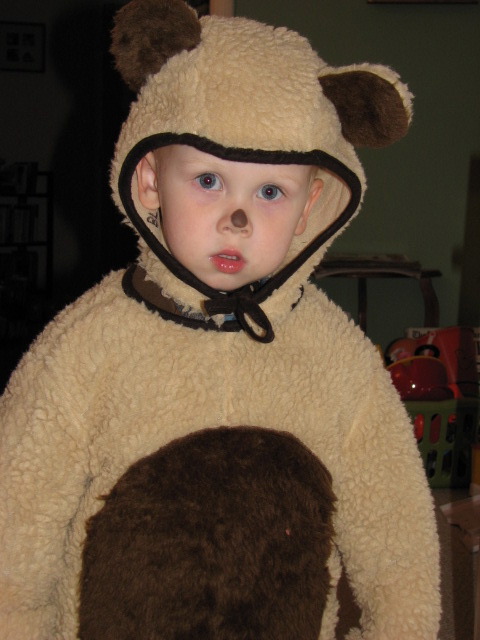
Here's our little brown bear ready to go out on Halloween. He did an excellent job, tripping up to every house, knocking on the door, and calling "Trick or treat!" He even said "Thank you" and "Happy Halloween" most of the time.
Our street is on a hill, which meant three-quarters of the houses had four or five cement steps between the sidewalk and the walk leading to the front door. Very few of them were lit, which slowed us down considerably. After an hour Ron and I were exhausted from painstakingly helping Benny step by step. (Carrying him, of course was OUT of the question.) Next year I'm bringing a flashlight.
Wednesday, September 20, 2006
I Really Hate Sewing
Hoo boy, things are a little wacky this week. Benny came down with some flippy virus over the weekend, involving a low-grade fever and some spectacular vomiting in the middle of the night (seriously, I was cleaning stuff out of his ear).
At the same time, I was cresting a major wave in my novel. For months I've been desperately sewing my plot together to fit the new climax I planned. Scenes between the heroine and villain were particularly tricky, since theirs is the big clash at the end of the book. So I cut and recut the pattern, sewed all those stupid little stitches, and now (to stretch this analogy to the utmost) I'm praying it will all hang together.
But for better or worse, the middle of this novel is done. I'm in the last quarter of the book, where the repercussions of people's actions will roll out in a steep, smooth path towards total disaster (I hope).
This means that for the last week, I've been a little novel-obsessed: scribbling on index cards, writing during Benny's naps, muttering to myself while I drive. The house has gone to hell and we have NO clean clothes. I spent Saturday afternoon frantically typing while poor Benny slept on my lap.
But I'm done writing for now, thank God, because this week is looking crazier by the minute. I have an interview today in Farmington Hills (in Metro Detroit) to write scripts for a small business cable channel. Wish me luck.
Tomorrow night I'm headed to semi-formal event in Warren (also in Metro Detroit) to celebrate a friend's award at a local film festival. John produced and directed "The Europa Society," and has scene great success with his short film "The Adventure Golf Guy." ("It's not miniature golf, it's adventure golf!")
Ron and I love Janelle, Benny's new babysitter, but we're a little nervous about leaving her with Benny while we go out of town. So Ron will stay home while I attend the event with a girlfriend from my playwriting group. It ought to be fun.
Then on Friday night I head to Metro Detroit AGAIN. Ron and I will attend an awards gala in Sterling Heights hosted by Automation Alley, a local business "consortium." It's a big business event and we can't miss it. Ron's got his tux and I have managed to pour myself into one of my size 8 gowns. (Amazing!)
Logistically, this will be a tricky few days, involving much driving around the construction-infested Detroit freeways while peering at MapQuest pages. I'm tired just thinking about it.
At the same time, I was cresting a major wave in my novel. For months I've been desperately sewing my plot together to fit the new climax I planned. Scenes between the heroine and villain were particularly tricky, since theirs is the big clash at the end of the book. So I cut and recut the pattern, sewed all those stupid little stitches, and now (to stretch this analogy to the utmost) I'm praying it will all hang together.
But for better or worse, the middle of this novel is done. I'm in the last quarter of the book, where the repercussions of people's actions will roll out in a steep, smooth path towards total disaster (I hope).
This means that for the last week, I've been a little novel-obsessed: scribbling on index cards, writing during Benny's naps, muttering to myself while I drive. The house has gone to hell and we have NO clean clothes. I spent Saturday afternoon frantically typing while poor Benny slept on my lap.
But I'm done writing for now, thank God, because this week is looking crazier by the minute. I have an interview today in Farmington Hills (in Metro Detroit) to write scripts for a small business cable channel. Wish me luck.
Tomorrow night I'm headed to semi-formal event in Warren (also in Metro Detroit) to celebrate a friend's award at a local film festival. John produced and directed "The Europa Society," and has scene great success with his short film "The Adventure Golf Guy." ("It's not miniature golf, it's adventure golf!")
Ron and I love Janelle, Benny's new babysitter, but we're a little nervous about leaving her with Benny while we go out of town. So Ron will stay home while I attend the event with a girlfriend from my playwriting group. It ought to be fun.
Then on Friday night I head to Metro Detroit AGAIN. Ron and I will attend an awards gala in Sterling Heights hosted by Automation Alley, a local business "consortium." It's a big business event and we can't miss it. Ron's got his tux and I have managed to pour myself into one of my size 8 gowns. (Amazing!)
Logistically, this will be a tricky few days, involving much driving around the construction-infested Detroit freeways while peering at MapQuest pages. I'm tired just thinking about it.
Thursday, September 14, 2006
Like Fathers, Like Sons

Here is Benny with his friends Harrison and Quinn at Gallup Park today. Harrison and Quinn's father Matt works with Ron, and it's striking how much these boys look and act like their fathers. Matt is a very serious, dignified guy and Ron is ... well, nuts.
(Click on the picture to see it better.)
Monday, September 11, 2006
Order the Chili-Cheese Dumbdog
This was a kick-ass writing day. Wrote two chapters and solved the problem of my unconscious heroine. Andie was out cold for three days, and wakes up in a hotel room.
Somehow I had to bring her up to speed on events over the last few days, so I had her wake up and squabble with her colleagues. ("You want me to attend a geology conference? And give a TALK? Are you nuts?") Then she heads out to find her missing friend.
She stops in at a diner. It's an odd place, really. You have to punch in a code to order. She thought she ordered waffles and ended up with a Chili-Cheese Dumbdog. Also, the chairs start rocking wildly when a diner exceeds his allotted eating time.
Anyway, CNN is on the diner's TV, so my heroine watched another main character (a powerful politician) being interviewed by a zany reporter. That brought her up to date and was more fun to write than my heroine reading a newspaper (yuk) or watching a regular newscast.
Now she has to dig up a legal case in the Hall of Records. I'm trying to remember my days as a circuit court reporter. Bureaucracies never change.
Somehow I had to bring her up to speed on events over the last few days, so I had her wake up and squabble with her colleagues. ("You want me to attend a geology conference? And give a TALK? Are you nuts?") Then she heads out to find her missing friend.
She stops in at a diner. It's an odd place, really. You have to punch in a code to order. She thought she ordered waffles and ended up with a Chili-Cheese Dumbdog. Also, the chairs start rocking wildly when a diner exceeds his allotted eating time.
Anyway, CNN is on the diner's TV, so my heroine watched another main character (a powerful politician) being interviewed by a zany reporter. That brought her up to date and was more fun to write than my heroine reading a newspaper (yuk) or watching a regular newscast.
Now she has to dig up a legal case in the Hall of Records. I'm trying to remember my days as a circuit court reporter. Bureaucracies never change.
Tuesday, September 05, 2006
Pagan Cross-Stitching and Other Thoughts
Well, I've hit another snag in my novel, and I'm not sure how to unravel it. My heroine was kidnapped, out cold for three days, and now she wakes up in Book Three in a nice safe hospital bed. Lots of stuff happened in those three days, but since this novel is primarily in her point of view, and it's important she gets up to speed quickly, I've got to review the last few days.
This is hard to do without it sounding like a soap opera summary. ("This week, Donna confessed to Paul, Fred hit Lana with his car, Myrna told Jeff the baby was Troy's, when it was really Walter's, Diane took up pagan cross-stitching and Brianna confronted her demon-possessed stepmother Janel, who stole her math homework to complete a sick Satanic ritual.)
All my attempts sound like that ridiculous bedside scene in "The Fellowship of the Ring," where a desperately wounded Frodo is running from the Ringwraiths, then wakes up in bed on a sunny morning. Gandalf the wizard then rambles on for pages and pages, getting Frodo up to date on everything. Yawn.
Back to my saga. My heroine's sister stole a fleet of ships during those three days and is on a rescue mission, with a little corpse hunting on the side (don't ask). It won't do any good to write chapters dramatizing this, from the sister's point of view, cuz my heroine will still need to wake up and learn all about it. And it seems like a copout to write: "Andie hobbled to the computer and did a Google search on her sister. She was shocked that Percy would behave so, etc., etc."
Another option is having Andie drag information out of a well-informed buddy, one who's reluctant to tell Andie anything because it might impede her recovery. But that still smacks of the whole Gandalf-Frodo scene.
Should Andie read a newspaper? Watch TV? Yawn.
Perhaps I'll have Percy write Andie a letter. A smug, patronizing, but cryptic letter from a bossy sister ought to make Andie plenty mad while getting basic information across. Andie will immediately stomp out of the hospital to go do the opposite of what Percy wants.
Or maybe Andie's nurses will act out recent events using finger puppets and funny voices. Who knows?
This is hard to do without it sounding like a soap opera summary. ("This week, Donna confessed to Paul, Fred hit Lana with his car, Myrna told Jeff the baby was Troy's, when it was really Walter's, Diane took up pagan cross-stitching and Brianna confronted her demon-possessed stepmother Janel, who stole her math homework to complete a sick Satanic ritual.)
All my attempts sound like that ridiculous bedside scene in "The Fellowship of the Ring," where a desperately wounded Frodo is running from the Ringwraiths, then wakes up in bed on a sunny morning. Gandalf the wizard then rambles on for pages and pages, getting Frodo up to date on everything. Yawn.
Back to my saga. My heroine's sister stole a fleet of ships during those three days and is on a rescue mission, with a little corpse hunting on the side (don't ask). It won't do any good to write chapters dramatizing this, from the sister's point of view, cuz my heroine will still need to wake up and learn all about it. And it seems like a copout to write: "Andie hobbled to the computer and did a Google search on her sister. She was shocked that Percy would behave so, etc., etc."
Another option is having Andie drag information out of a well-informed buddy, one who's reluctant to tell Andie anything because it might impede her recovery. But that still smacks of the whole Gandalf-Frodo scene.
Should Andie read a newspaper? Watch TV? Yawn.
Perhaps I'll have Percy write Andie a letter. A smug, patronizing, but cryptic letter from a bossy sister ought to make Andie plenty mad while getting basic information across. Andie will immediately stomp out of the hospital to go do the opposite of what Percy wants.
Or maybe Andie's nurses will act out recent events using finger puppets and funny voices. Who knows?
Thursday, August 24, 2006
Great Hades! Pluto's Not a Planet!
New York Times article
Well, it's official. A bunch of astronomers in Prague have plucked Pluto out of the planet lineup and tossed it into an icy trash bin labeled "Trans-Neptunian Objects."
And I, for one, am pretty upset about it. Not just because Pluto’s one of my favorite planets – that small, icy changeling with the big moon and funky orbit. Like the other planets, it took its name from Roman mythology based on a specific characteristic. (Mercury is fast, Venus is pretty, Jupiter is big, Saturn is slow … you get the picture.)
Named after the God of the Underworld, Pluto’s name evokes more than an ancient god. It’s a place: dark, harsh, cold, remote, a true underworld. Its largest moon, Charon, is named after the ferryman who took dead souls across the River Styx into the Underworld. Its two smaller moons, Hydra and Nix, are named after a nine-headed monster and the Goddess of Night.
But now the International Astronomical Union, drunk with new data about the numerous icy bodies beyond Pluto, launched a thorough housecleaning of the whole classification system. Their central question: what is a planet?
It is, admittedly, a tricky question: if a planet is simply a round object that revolves around the sun, then astronomers would have to promote Ceres, the biggest asteroid in the asteroid belt and Xena, that new planet beyond Pluto. And then what if scientists find a zillion more little worlds? Are they all planets too?
The astronomers didn’t solve this problem like scientists; they solved it like bureaucrats. Determined to strip Pluto of its rank, they sought a clear way to separate it from the other planets beyond the basic criteria: “It’s really small and way the fuck out there.”
So they said a planet, in addition to being round and revolving around the sun, “must have cleared other things out of the way in its orbital neighborhood.” In other words, it had to be alone, except for objects orbiting around it, like moons or rings. That knocked out Ceres in the asteroid belt and Xena in the Kuiper Belt.
Sounds like Pluto’s safe, right? It’s got three moons. Well, Pluto was betrayed by its largest moon: Charon. Apparently Charon doesn’t orbit Pluto like most moons do, the center of gravity is between them. So boom! There goes Pluto on a technicality.
I suppose these astronomers know what they’re talking about when they discuss centers of gravities of objects 3.7 billion miles away. But they’ll look pretty stupid if the NASA's New Horizons spacecraft turns up at Pluto in 2015 and finds out they were wrong.
I think it’s kind of creepy that something so basic in our scientific culture can be changed like this, just because a planet is small and distant. Does this mean a bunch of cartographers will gather in Lisbon next month and decide that Australia isn’t a continent?
Or will Congress enact a law that Hawaii is no longer a state? (“Our new definition of a state includes 'must be connected to the North American landmass. And yeah, Hawaii is small and way the fuck out there.'”)
Scientist by their very nature like things all nice and tidy, but the universe will never cooperate. I’m rushing out today and buying Benny a Solar System mobile with NINE Styrofoam balls. Maybe I’ll have to add a little Xena, but they'll never take my Pluto away.
Well, it's official. A bunch of astronomers in Prague have plucked Pluto out of the planet lineup and tossed it into an icy trash bin labeled "Trans-Neptunian Objects."
And I, for one, am pretty upset about it. Not just because Pluto’s one of my favorite planets – that small, icy changeling with the big moon and funky orbit. Like the other planets, it took its name from Roman mythology based on a specific characteristic. (Mercury is fast, Venus is pretty, Jupiter is big, Saturn is slow … you get the picture.)
Named after the God of the Underworld, Pluto’s name evokes more than an ancient god. It’s a place: dark, harsh, cold, remote, a true underworld. Its largest moon, Charon, is named after the ferryman who took dead souls across the River Styx into the Underworld. Its two smaller moons, Hydra and Nix, are named after a nine-headed monster and the Goddess of Night.
But now the International Astronomical Union, drunk with new data about the numerous icy bodies beyond Pluto, launched a thorough housecleaning of the whole classification system. Their central question: what is a planet?
It is, admittedly, a tricky question: if a planet is simply a round object that revolves around the sun, then astronomers would have to promote Ceres, the biggest asteroid in the asteroid belt and Xena, that new planet beyond Pluto. And then what if scientists find a zillion more little worlds? Are they all planets too?
The astronomers didn’t solve this problem like scientists; they solved it like bureaucrats. Determined to strip Pluto of its rank, they sought a clear way to separate it from the other planets beyond the basic criteria: “It’s really small and way the fuck out there.”
So they said a planet, in addition to being round and revolving around the sun, “must have cleared other things out of the way in its orbital neighborhood.” In other words, it had to be alone, except for objects orbiting around it, like moons or rings. That knocked out Ceres in the asteroid belt and Xena in the Kuiper Belt.
Sounds like Pluto’s safe, right? It’s got three moons. Well, Pluto was betrayed by its largest moon: Charon. Apparently Charon doesn’t orbit Pluto like most moons do, the center of gravity is between them. So boom! There goes Pluto on a technicality.
I suppose these astronomers know what they’re talking about when they discuss centers of gravities of objects 3.7 billion miles away. But they’ll look pretty stupid if the NASA's New Horizons spacecraft turns up at Pluto in 2015 and finds out they were wrong.
I think it’s kind of creepy that something so basic in our scientific culture can be changed like this, just because a planet is small and distant. Does this mean a bunch of cartographers will gather in Lisbon next month and decide that Australia isn’t a continent?
Or will Congress enact a law that Hawaii is no longer a state? (“Our new definition of a state includes 'must be connected to the North American landmass. And yeah, Hawaii is small and way the fuck out there.'”)
Scientist by their very nature like things all nice and tidy, but the universe will never cooperate. I’m rushing out today and buying Benny a Solar System mobile with NINE Styrofoam balls. Maybe I’ll have to add a little Xena, but they'll never take my Pluto away.
Friday, August 11, 2006
Pursuit of Power III: The Cure is Worse than the Disease
When we last chatted with William H. McNeill, author of “Pursuit of Power,” old military patterns were busy withering and dying in the 17th century. You could almost hear him cackling and rubbing his hands, crying “Now I can prove my thesis! Hahahahaha!”
Maurice of Nassau and his buds had developed new methods of army organization, and their ideas spread through the world like a virus. McNeill triumphantly returned to his big medical analogy, reminding us how military changes resemble the genetic mutations of microorganisms; they break down old limits or explore new geography.
So now warmakers had the fancy weapons, the new drills, the bitty regiments. The developments kindled in Holland in the 16th century spread like wildfire. In the 17th century the new methods hit western Europe; in the 18th, they transformed Russia under Peter the Great. Then the methods spread to the New World and India during colonial expansion and infected even the Ottoman Empire.
Hoo boy. But these new methods weren’t all-powerful. Generals still had problems controlling armies of more than 50,000 men. They needed better ways to communicate. They needed some decent topographical maps. Supply was a big problem. (Isn’t it always?) Personnel administration was still all screwy, with meatheads with money and connections beating out professional officers for advancement. (That’s changed?) But most of all, war was still a sport of kings. Civilians were left alone.
But not for long. The French Revolution broke social barriers, and then the Industrial Revolution solved communication and supply problems and brought in more nifty new weapons. War became industrialized, Germany was united, everyone in Europe was squabbling, and the next thing you knew, you had World War I.
Talk about breaking old limits. As long as all military movement except for trains depended on horses or humans, the limit of muscles were the limits of armies. But the internal combustion engine changed all that, McNeill said, beginning with the taxicabs that carried French soldiers from Paris for the first Battle of the Marne in 1914.
Even a serious dude like McNeill admitted that World War I was bizarre. Germany, Britain and France were willing to fight despite massive deaths and military stalemate. McNeill tried to explain it, but gave up after a rambling page or two.
You could almost feel his relief as he turned to armaments, treating us to pages of tank photos. Tanks were first developed in 1916, and two years later they were all along the front line.
The British high command even came out with this amazing plan, called Plan 1919. I’d never heard of this plan. Apparently it laid out the blitzkrieg tactics the Germans used 20 years later in Poland. But the war ended a year early, and the Brits never used it.
But it’s still intriguing. Military eggheads before then tended to draw plans based on weapons that, um, actually existed. The British planners, on the other hand, tried to shape the future by deliberately altering the development of weapons to fit the needs of the plan. I can just see them sketching out Plan 1919 to their subordinates, airily saying, “Now if we can just put some big guns on treads, old boy …”
Except for this interesting aside, McNeill used the rest of this book to launch a broad, sociopolitical discussion of the two world wars. I plowed through some of it, but it made my head hurt. So I gave “Pursuit of Power” a respectful farewell salute and toddled off to watch “Supernanny.”
So did McNeill prove his thesis? I don’t feel qualified to judge. I mean, when you think about it, it’s a weird little thesis. So the advanced armies are the deadly viruses, and the backward natives are the once-healthy cells, falling by the millions to the scythe of progress. Does that make my new buddy Maurice a genetic mutation? Oooh, my head hurts.
I think McNeill successfully showed how technological advances in weapons break previous limits, allowing armies to run amok until they hit new limits. Seventeenth-century armies became unwieldy at 50,000 because communication broke down. Then came telegraphs and phones and armies grew larger.
Now we have the Internet and satellites, and the sizes of future armies seem almost infinite. Perhaps if we refrain from blowing ourselves up long enough to develop space travel, we’ll see history repeat itself over planets and systems instead of countries and continents.
And perhaps that’s one of the book’s points. In mankind’s pursuit of power, our ambition will always outstrip our capabilities. Yet while our reach exceeds our grasp, we struggle to handle the technology we hold now, today. We’re like greedy toddlers, unable to eat the candy in our hands, yet always crying for more.
##
Maurice of Nassau and his buds had developed new methods of army organization, and their ideas spread through the world like a virus. McNeill triumphantly returned to his big medical analogy, reminding us how military changes resemble the genetic mutations of microorganisms; they break down old limits or explore new geography.
So now warmakers had the fancy weapons, the new drills, the bitty regiments. The developments kindled in Holland in the 16th century spread like wildfire. In the 17th century the new methods hit western Europe; in the 18th, they transformed Russia under Peter the Great. Then the methods spread to the New World and India during colonial expansion and infected even the Ottoman Empire.
Hoo boy. But these new methods weren’t all-powerful. Generals still had problems controlling armies of more than 50,000 men. They needed better ways to communicate. They needed some decent topographical maps. Supply was a big problem. (Isn’t it always?) Personnel administration was still all screwy, with meatheads with money and connections beating out professional officers for advancement. (That’s changed?) But most of all, war was still a sport of kings. Civilians were left alone.
But not for long. The French Revolution broke social barriers, and then the Industrial Revolution solved communication and supply problems and brought in more nifty new weapons. War became industrialized, Germany was united, everyone in Europe was squabbling, and the next thing you knew, you had World War I.
Talk about breaking old limits. As long as all military movement except for trains depended on horses or humans, the limit of muscles were the limits of armies. But the internal combustion engine changed all that, McNeill said, beginning with the taxicabs that carried French soldiers from Paris for the first Battle of the Marne in 1914.
Even a serious dude like McNeill admitted that World War I was bizarre. Germany, Britain and France were willing to fight despite massive deaths and military stalemate. McNeill tried to explain it, but gave up after a rambling page or two.
You could almost feel his relief as he turned to armaments, treating us to pages of tank photos. Tanks were first developed in 1916, and two years later they were all along the front line.
The British high command even came out with this amazing plan, called Plan 1919. I’d never heard of this plan. Apparently it laid out the blitzkrieg tactics the Germans used 20 years later in Poland. But the war ended a year early, and the Brits never used it.
But it’s still intriguing. Military eggheads before then tended to draw plans based on weapons that, um, actually existed. The British planners, on the other hand, tried to shape the future by deliberately altering the development of weapons to fit the needs of the plan. I can just see them sketching out Plan 1919 to their subordinates, airily saying, “Now if we can just put some big guns on treads, old boy …”
Except for this interesting aside, McNeill used the rest of this book to launch a broad, sociopolitical discussion of the two world wars. I plowed through some of it, but it made my head hurt. So I gave “Pursuit of Power” a respectful farewell salute and toddled off to watch “Supernanny.”
So did McNeill prove his thesis? I don’t feel qualified to judge. I mean, when you think about it, it’s a weird little thesis. So the advanced armies are the deadly viruses, and the backward natives are the once-healthy cells, falling by the millions to the scythe of progress. Does that make my new buddy Maurice a genetic mutation? Oooh, my head hurts.
I think McNeill successfully showed how technological advances in weapons break previous limits, allowing armies to run amok until they hit new limits. Seventeenth-century armies became unwieldy at 50,000 because communication broke down. Then came telegraphs and phones and armies grew larger.
Now we have the Internet and satellites, and the sizes of future armies seem almost infinite. Perhaps if we refrain from blowing ourselves up long enough to develop space travel, we’ll see history repeat itself over planets and systems instead of countries and continents.
And perhaps that’s one of the book’s points. In mankind’s pursuit of power, our ambition will always outstrip our capabilities. Yet while our reach exceeds our grasp, we struggle to handle the technology we hold now, today. We’re like greedy toddlers, unable to eat the candy in our hands, yet always crying for more.
##
Thursday, July 27, 2006
Pursuit of Power II: Christine Meets a New Guy
Despite my best intentions, I abandoned McNeill’s “Pursuit of Power” after the first chapter and spent two evenings watching TV instead.
But Monday night, which offered a choice between reruns of "Hell's Kitchen," "Project Runway" and "Wife Swap," drove me back to reading. So I gave Chapter Two a try.
McNeill was yakking about the years 1000-1500, when Chinese advancements in industry and armaments anticipated European achievements by several centuries.
So why didn’t a Chinese Columbus discover America? China had the iron and the coal industries and the powerful sailing ships. They had paper money and crossbows and guns and gunpowder and Confucious knew what else.
The book’s answer was that to exploit such advancements, a society had to support lots of merchants and manufacturers. But China didn't want to do this. Their society had different values. Chinese merchants and manufacturers couldn't flourish. Instead of passing their crafts to their sons, merchants and manufacturers put their limited profits into education and land for their boys. The Chinese government controlled everything through Confucianism, and Confucianism didn't like the marketplace.
Europe could have gone the same way in those years, McNeill said. Christianity didn't think much of the marketplace either. If the Popes Innocent III and Boniface VIII had succeeded in uniting western Europe under a papal government (a true Holy Roman Empire), Europe might’ve been like China.
But the popes couldn't pull it off. Apparently God wanted Europeans to buy light artillery on a large scale. So Europe remained a puzzle of states and markets could flourish in the cracks, building increasingly powerful weapons. Gee, what a relief. Cuz the world really needed those cannons and muskets.
Meanwhile, back to Chapter Four. Military history books often remind me of small-town newspapers: the same people keep popping up again and again. If you’re studying the 12th century, you get Ghengis Khan; if you’re in the 1500s, you find Elizabeth of England and Philip of Spain.
Now McNeill was discussing the Thirty Year’s War in the 1600s, and the Swedish king Gustav Adolf promptly floated up like Banquo’s ghost. Oh, hi there, Gustav, how ya doing – still fighting the Battle of Breitenfeld? Go get ‘em, man.
But then a new guy marched onto page 126: Maurice of Nassau, Prince of Orange, captain-general of Holland and Zeeland in the 1500s. How come nobody told me about this dude? I thought Zeeland was a boring town in west Michigan. (1)
Maurice was a drill sergeant – literally. Confronted by the Spaniards and their weird little tercios (2), he dreamed up the idea of systematic drilling to make his soldiers more efficient. He analyzed the complicated motions needed to load and fire a matchlock rifle and came up with the number 42. (3) He taught his soldiers to make each movement in unison, responding to a shouted command.
That’s where the guy on the cover of this book, the soldier in the red poofy pants, came in. Drillmasters used pictures showing each of the 42 motions, all displaying the same funny guy: he fired his musket, took down the musket, uncocked the match, blew on the pan, charged the musket, etc. They’re lovely pictures, made from engravings, although stick figures probably would have done just as well.
But Maurice did more than hand out pictures. He introduced regular marching and smaller tactical units and made his guys dig entrenchments with spades.
“Powess and physical courage all but disappeared under an ironclad routine,” McNeill said. “The old heroic patterns of military behavior withered and died.”
_________________________________
(1) The real Zeeland is a province in the Netherlands. Dutch settlers brought the names to Michigan, so now we have the thrilling locales of Holland and Zeeland, 5 miles apart on the highway to Grand Rapids. Yippee.
(2) The tercios were a formidable force in the 1500s: a crowd of pikemen (guys carrying long wooden poles) protecting a fringe of musketeers posted around a central square of more pikemen. The Spaniards loved their tercios and insisted on sending them out long after their usefulness had ended.
(3) The answer to life, the universe and Everything.
But Monday night, which offered a choice between reruns of "Hell's Kitchen," "Project Runway" and "Wife Swap," drove me back to reading. So I gave Chapter Two a try.
McNeill was yakking about the years 1000-1500, when Chinese advancements in industry and armaments anticipated European achievements by several centuries.
So why didn’t a Chinese Columbus discover America? China had the iron and the coal industries and the powerful sailing ships. They had paper money and crossbows and guns and gunpowder and Confucious knew what else.
The book’s answer was that to exploit such advancements, a society had to support lots of merchants and manufacturers. But China didn't want to do this. Their society had different values. Chinese merchants and manufacturers couldn't flourish. Instead of passing their crafts to their sons, merchants and manufacturers put their limited profits into education and land for their boys. The Chinese government controlled everything through Confucianism, and Confucianism didn't like the marketplace.
Europe could have gone the same way in those years, McNeill said. Christianity didn't think much of the marketplace either. If the Popes Innocent III and Boniface VIII had succeeded in uniting western Europe under a papal government (a true Holy Roman Empire), Europe might’ve been like China.
But the popes couldn't pull it off. Apparently God wanted Europeans to buy light artillery on a large scale. So Europe remained a puzzle of states and markets could flourish in the cracks, building increasingly powerful weapons. Gee, what a relief. Cuz the world really needed those cannons and muskets.
Meanwhile, back to Chapter Four. Military history books often remind me of small-town newspapers: the same people keep popping up again and again. If you’re studying the 12th century, you get Ghengis Khan; if you’re in the 1500s, you find Elizabeth of England and Philip of Spain.
Now McNeill was discussing the Thirty Year’s War in the 1600s, and the Swedish king Gustav Adolf promptly floated up like Banquo’s ghost. Oh, hi there, Gustav, how ya doing – still fighting the Battle of Breitenfeld? Go get ‘em, man.
But then a new guy marched onto page 126: Maurice of Nassau, Prince of Orange, captain-general of Holland and Zeeland in the 1500s. How come nobody told me about this dude? I thought Zeeland was a boring town in west Michigan. (1)
Maurice was a drill sergeant – literally. Confronted by the Spaniards and their weird little tercios (2), he dreamed up the idea of systematic drilling to make his soldiers more efficient. He analyzed the complicated motions needed to load and fire a matchlock rifle and came up with the number 42. (3) He taught his soldiers to make each movement in unison, responding to a shouted command.
That’s where the guy on the cover of this book, the soldier in the red poofy pants, came in. Drillmasters used pictures showing each of the 42 motions, all displaying the same funny guy: he fired his musket, took down the musket, uncocked the match, blew on the pan, charged the musket, etc. They’re lovely pictures, made from engravings, although stick figures probably would have done just as well.
But Maurice did more than hand out pictures. He introduced regular marching and smaller tactical units and made his guys dig entrenchments with spades.
“Powess and physical courage all but disappeared under an ironclad routine,” McNeill said. “The old heroic patterns of military behavior withered and died.”
_________________________________
(1) The real Zeeland is a province in the Netherlands. Dutch settlers brought the names to Michigan, so now we have the thrilling locales of Holland and Zeeland, 5 miles apart on the highway to Grand Rapids. Yippee.
(2) The tercios were a formidable force in the 1500s: a crowd of pikemen (guys carrying long wooden poles) protecting a fringe of musketeers posted around a central square of more pikemen. The Spaniards loved their tercios and insisted on sending them out long after their usefulness had ended.
(3) The answer to life, the universe and Everything.
Friday, July 21, 2006
Pursuit of Power I: Deadly Germs in Poofy Pants
"The Pursuit of Power: Technology, Armed Forces and Society since A.D. 1000" by William H. McNeill.Amazon.com listing
I’ll admit, I picked up my library copy of William H. McNeill’s “Pursuit of Power” with some trepidation. The book was yellowed and waterstained and the cover showed some weird guy in a teeny feathered hat and poofy red pants.
As usual, I skipped the preface. I can’t stand prefaces, where an author describes the epiphany that led to the book (“… and so I wondered, why hasn’t a thorough discussion of nickel-iron octahedrites been attempted?”). Then the author spends two pages thanking everyone but their dry cleaner. (“… To my Uncle Mervin, who offered many helpful suggestions when he wasn’t drunk.”)
So I turned to chapter one: “Arms and Society of Antiquity.”
And stopped dead.
I didn’t understand a word of it. What’s all this about the “industrialization of war”? Why is he talking about bronze? Who cares where tin was mined? This is ridiculous, I thought, I could be watching “America’s Got Talent.”
I sighed. Perhaps I should read the preface after all. It was only two pages, not counting the acknowledgements (“Thank you Hugh, for piloting me through the intricacies of Chinese historiography.”)
Thank heavens I read it. This book had a point, and McNeill wasn’t afraid to clearly lay it out in the preface. He’d published a book a few years before called “Plagues and Peoples,” dealing with the interactions between people and microparasites. A creepy topic really. I dislike reading plague books, which leave me twitchy and prone to examining my tongue in the mirror.
In “Plagues and Peoples,” McNeill addressed the abrupt changes that occur in organisms due to a mutation or a change in environment, changes that briefly allow them to escape previous limits. The most important microparasites affecting people were disease germs, so he wrote about those.
In “Pursuit of Power,” McNeill turned his attention to macroparasites. The most important macroparasites affecting people were other people, violent conquerors who snatched all the good food, shelter and pretty girls without contributing anything.
Therefore, macroparasitism among people turns into a study of the armed forces, with special attention to war equipment. Changes in armaments resemble the genetic mutations of microorganisms; they break down old limits or explore new geography.
To take this analogy further (and McNeill stretched it to the limit), well-equipped and organized armies meeting a more backward society act like deadly germs attacking a patient. The advanced guy almost always wins.
And where does this leave us? In real trouble, according to McNeill. As war became more advanced, increasingly dependent on industrial might, muscles and courage became less important. But our “ancient, inherited psychic aptitudes” remain the same. We still want to beat our breastplates and rattle our spears, but now our spears are rockets and nuclear missiles.
Now, isn’t that just jolly. Aren’t you glad I read the preface? Well, it had to be done. I returned to that first paragraph in chapter one, “Arms and Society in Antiquity,” and it made a little better sense now. A little.
“The industrialization of war is almost as old as civilization,” McNeill said. Privileged fighting men used bronze weapons and armor made by specialists. This wasn’t really industrialization, though, because it was so small-scale. It took a ton of painstaking work to make a warrior’s full panopoly and the stuff lasted forever.
But things change. McNeill says. “One can detect in the historic record a series of important changes in weapons systems resulting from sporadic technical discoveries and inventions that sufficed to change preexisting conditions of warfare and army organization.”
In other words, as germs mutated to cause ever more dangerous diseases, new weapons were invented to cause more destructive wars. In both cases, the old limits no longer held, and wholesale craziness broke out for a while until an equilibrium was established.
And what were these changes? The first was our old buddy bronze, not because it made pretty armor, but because it led to improved designs for war chariots. The new designs meant lots of guys could have chariots now, not just the rich ones. Whole armies could roll around the battlefield, shooting arrows. That meant populations with lots of horses could kick some serious butt.
The next change was iron, which meant every guy could get his own armor and wreak a little havoc. Then came what McNeill called “the cavalry revolution.” Guys learned to ride and shoot their bows at the same time. The steppe nomads loved this, and the next thing you knew, you had Genghis Khan in your backyard.
For the last big change in antiquity, we can thank the Iranians, who bred bigger horses, horses big enough to carry a guy in full metal armor. Armored horsemen cared less about arrows and could wave their maces and swords around. With that discovery, the age of antiquity was over and we could get into all that fun medieval stuff.
By the end of chapter one, I was OK with the book. McNeill’s writing was a little involved (I mean, look at the quote about weapons, and that was one of the simpler sentences). But he had a nice, organized mind and could reduce an insanely complicated topic into something I could wrap my head around. I was prepared to read on. Maybe I’d learn something about the weird guy in the red poofy pants.
I’ll admit, I picked up my library copy of William H. McNeill’s “Pursuit of Power” with some trepidation. The book was yellowed and waterstained and the cover showed some weird guy in a teeny feathered hat and poofy red pants.
As usual, I skipped the preface. I can’t stand prefaces, where an author describes the epiphany that led to the book (“… and so I wondered, why hasn’t a thorough discussion of nickel-iron octahedrites been attempted?”). Then the author spends two pages thanking everyone but their dry cleaner. (“… To my Uncle Mervin, who offered many helpful suggestions when he wasn’t drunk.”)
So I turned to chapter one: “Arms and Society of Antiquity.”
And stopped dead.
I didn’t understand a word of it. What’s all this about the “industrialization of war”? Why is he talking about bronze? Who cares where tin was mined? This is ridiculous, I thought, I could be watching “America’s Got Talent.”
I sighed. Perhaps I should read the preface after all. It was only two pages, not counting the acknowledgements (“Thank you Hugh, for piloting me through the intricacies of Chinese historiography.”)
Thank heavens I read it. This book had a point, and McNeill wasn’t afraid to clearly lay it out in the preface. He’d published a book a few years before called “Plagues and Peoples,” dealing with the interactions between people and microparasites. A creepy topic really. I dislike reading plague books, which leave me twitchy and prone to examining my tongue in the mirror.
In “Plagues and Peoples,” McNeill addressed the abrupt changes that occur in organisms due to a mutation or a change in environment, changes that briefly allow them to escape previous limits. The most important microparasites affecting people were disease germs, so he wrote about those.
In “Pursuit of Power,” McNeill turned his attention to macroparasites. The most important macroparasites affecting people were other people, violent conquerors who snatched all the good food, shelter and pretty girls without contributing anything.
Therefore, macroparasitism among people turns into a study of the armed forces, with special attention to war equipment. Changes in armaments resemble the genetic mutations of microorganisms; they break down old limits or explore new geography.
To take this analogy further (and McNeill stretched it to the limit), well-equipped and organized armies meeting a more backward society act like deadly germs attacking a patient. The advanced guy almost always wins.
And where does this leave us? In real trouble, according to McNeill. As war became more advanced, increasingly dependent on industrial might, muscles and courage became less important. But our “ancient, inherited psychic aptitudes” remain the same. We still want to beat our breastplates and rattle our spears, but now our spears are rockets and nuclear missiles.
Now, isn’t that just jolly. Aren’t you glad I read the preface? Well, it had to be done. I returned to that first paragraph in chapter one, “Arms and Society in Antiquity,” and it made a little better sense now. A little.
“The industrialization of war is almost as old as civilization,” McNeill said. Privileged fighting men used bronze weapons and armor made by specialists. This wasn’t really industrialization, though, because it was so small-scale. It took a ton of painstaking work to make a warrior’s full panopoly and the stuff lasted forever.
But things change. McNeill says. “One can detect in the historic record a series of important changes in weapons systems resulting from sporadic technical discoveries and inventions that sufficed to change preexisting conditions of warfare and army organization.”
In other words, as germs mutated to cause ever more dangerous diseases, new weapons were invented to cause more destructive wars. In both cases, the old limits no longer held, and wholesale craziness broke out for a while until an equilibrium was established.
And what were these changes? The first was our old buddy bronze, not because it made pretty armor, but because it led to improved designs for war chariots. The new designs meant lots of guys could have chariots now, not just the rich ones. Whole armies could roll around the battlefield, shooting arrows. That meant populations with lots of horses could kick some serious butt.
The next change was iron, which meant every guy could get his own armor and wreak a little havoc. Then came what McNeill called “the cavalry revolution.” Guys learned to ride and shoot their bows at the same time. The steppe nomads loved this, and the next thing you knew, you had Genghis Khan in your backyard.
For the last big change in antiquity, we can thank the Iranians, who bred bigger horses, horses big enough to carry a guy in full metal armor. Armored horsemen cared less about arrows and could wave their maces and swords around. With that discovery, the age of antiquity was over and we could get into all that fun medieval stuff.
By the end of chapter one, I was OK with the book. McNeill’s writing was a little involved (I mean, look at the quote about weapons, and that was one of the simpler sentences). But he had a nice, organized mind and could reduce an insanely complicated topic into something I could wrap my head around. I was prepared to read on. Maybe I’d learn something about the weird guy in the red poofy pants.
Saturday, July 15, 2006
Christine's Military History Seminar Returns!
After a brief hiatus (ahem, nine months), I proudly announce the return of my own personal, private, slightly flaky military history seminar.
Longtime readers of this blog may recall how last fall's horrifying TV season drove me away from the tube and into the library. I've always been interested in military history, so I turned to the nice folks at Ohio State University. The history department posted a preliminary reading list on its web site. These folks are really hard-core; they actually consider a 100-book list comprised of six sections with authors like Clausewitz, Caesar and Thucydides a "preliminary list." I'd like to see the real list.
Here's the List
I began with Carl von Clausewitz's "On War," which nearly chased me from military history forever. Then I read Paul Kennedy's "The Rise and Fall of the Great Powers." Clause was very impressive, Kennedy less so. I had great fun abusing Kennedy.
Read my blogs about Clause
Clause the Sequel
Kennedy: Rise and Fall of a Really Long Book
Next on the hit parade is "The Pursuit of Power: Technology, Armed Forces and Society since A.D. 1000" by William H. McNeill. Gosh, reading the title alone makes me tired.
Longtime readers of this blog may recall how last fall's horrifying TV season drove me away from the tube and into the library. I've always been interested in military history, so I turned to the nice folks at Ohio State University. The history department posted a preliminary reading list on its web site. These folks are really hard-core; they actually consider a 100-book list comprised of six sections with authors like Clausewitz, Caesar and Thucydides a "preliminary list." I'd like to see the real list.
Here's the List
I began with Carl von Clausewitz's "On War," which nearly chased me from military history forever. Then I read Paul Kennedy's "The Rise and Fall of the Great Powers." Clause was very impressive, Kennedy less so. I had great fun abusing Kennedy.
Read my blogs about Clause
Clause the Sequel
Kennedy: Rise and Fall of a Really Long Book
Next on the hit parade is "The Pursuit of Power: Technology, Armed Forces and Society since A.D. 1000" by William H. McNeill. Gosh, reading the title alone makes me tired.
Friday, July 14, 2006
Long Live the Revolution!
Armed with basic media equipment and Internet access, the little people are fighting back!
Here is a poor schmuck just trying to cancel his AOL. His tragic story has now been featured in the New York Times and NBC's Today show.
Vinny Tries to Cancel AOL
And here is a clip called "A Comcast Technician is Sleeping on My Couch."
Nighty-NIght
Let the masses rejoice!
Here is a poor schmuck just trying to cancel his AOL. His tragic story has now been featured in the New York Times and NBC's Today show.
Vinny Tries to Cancel AOL
And here is a clip called "A Comcast Technician is Sleeping on My Couch."
Nighty-NIght
Let the masses rejoice!
Thursday, July 13, 2006
No-Benny Vacation, Part Two
Then the rains came.
They held off until afternoon, granting us a good morning at the beach. Ron splashed around in the chilly water while I lay on a towel and read "The Ladies No. 1 Detective Agency." Hunger drove us back to the Harbor House Inn, where we changed before lunch.
I had only 40 minutes before my pedicure, so we scarfed hot dogs at a diner and watched the gray clouds darken through the plate-glass windows. Then I placed myself in the gifted hands of Studio 506 for a basic pedicure with sparkly metallic polish.
I left the salon and stepped into a typhoon. Ron stood at a nearby corner, holding our only umbrella and clutching a plastic shopping bag to his chest. "Ice cream!" he said decidedly, ignoring my squeaks as I hopped around in those weird flip-flops salons give you.
"My pedicure!" I groaned, splashing ankle-deep into a puddle.
"There's an ice cream place!" Ron said. He handed me the umbrella and started forward.
There was no inside seating at the first ice cream parlor, or the second. We could now barely see through the wall of water, so I whisked us inside a Greek gyro place and collapsed into a booth. Undaunted, Ron left the restaurant and returned with his ice cream. More sodden tourists arrived, wiping their faces and wringing out their shorts, until the place was full. I didn't know there were that many people in Grand Haven.
Resigned to waiting, I looked over the local paper, The Grand Haven Tribune. Typical stuff, until I hit the editorial page. The first letter to the editor was from a visitor from Greenville.
____________________________________
"To the Editor:
"My husband and I chose to spend our Fourth of July this year in 'beautiful' Grand Haven.... After dealing with the congestion of pedestrians and traffic, we were very much looking forward to a relaxing dinner. We selected a popular establishment on Washington Street with outside seating ...."
(I could almost hear the jungle drums beating. What was ahead? An injury? A mugging? An offensively loud car stereo?)
"I looked over my husband's shoulder to see a man walking toward us wearing a huge snake around his neck .... I am deathly afraid of snakes ... and quickly left our table."
(End of problem, you might say. But the lady's ordeal was not over. She returned to the table only to encounter the snake man again.)
"I didn't hesitate to flee again to the safety inside the restaurant ... trembling and sobbing."
(I felt kind of bad for the lady at this point. But she wrote on.)
"My appetite for dinner and my love for Grand Haven were both gone .... Are these the kinds of tourists that Grand Haven is trying to attract? People that walk down the streets with exotic -- and [possibly unsafe) animals that scare women and children?"
__________________________________________
Well now. Perhaps it is best if this lady does not return to Grand Haven, especially if she seeks relaxation during one of the town's busiest weekends (my pedicure lady said it was wall-to-wall people over the Fourth). But I doubt the snake man was a tourist, and I'm not entirely convinced that the city should launch a campaign to reduce irresponsible reptile-walking.
They held off until afternoon, granting us a good morning at the beach. Ron splashed around in the chilly water while I lay on a towel and read "The Ladies No. 1 Detective Agency." Hunger drove us back to the Harbor House Inn, where we changed before lunch.
I had only 40 minutes before my pedicure, so we scarfed hot dogs at a diner and watched the gray clouds darken through the plate-glass windows. Then I placed myself in the gifted hands of Studio 506 for a basic pedicure with sparkly metallic polish.
I left the salon and stepped into a typhoon. Ron stood at a nearby corner, holding our only umbrella and clutching a plastic shopping bag to his chest. "Ice cream!" he said decidedly, ignoring my squeaks as I hopped around in those weird flip-flops salons give you.
"My pedicure!" I groaned, splashing ankle-deep into a puddle.
"There's an ice cream place!" Ron said. He handed me the umbrella and started forward.
There was no inside seating at the first ice cream parlor, or the second. We could now barely see through the wall of water, so I whisked us inside a Greek gyro place and collapsed into a booth. Undaunted, Ron left the restaurant and returned with his ice cream. More sodden tourists arrived, wiping their faces and wringing out their shorts, until the place was full. I didn't know there were that many people in Grand Haven.
Resigned to waiting, I looked over the local paper, The Grand Haven Tribune. Typical stuff, until I hit the editorial page. The first letter to the editor was from a visitor from Greenville.
____________________________________
"To the Editor:
"My husband and I chose to spend our Fourth of July this year in 'beautiful' Grand Haven.... After dealing with the congestion of pedestrians and traffic, we were very much looking forward to a relaxing dinner. We selected a popular establishment on Washington Street with outside seating ...."
(I could almost hear the jungle drums beating. What was ahead? An injury? A mugging? An offensively loud car stereo?)
"I looked over my husband's shoulder to see a man walking toward us wearing a huge snake around his neck .... I am deathly afraid of snakes ... and quickly left our table."
(End of problem, you might say. But the lady's ordeal was not over. She returned to the table only to encounter the snake man again.)
"I didn't hesitate to flee again to the safety inside the restaurant ... trembling and sobbing."
(I felt kind of bad for the lady at this point. But she wrote on.)
"My appetite for dinner and my love for Grand Haven were both gone .... Are these the kinds of tourists that Grand Haven is trying to attract? People that walk down the streets with exotic -- and [possibly unsafe) animals that scare women and children?"
__________________________________________
Well now. Perhaps it is best if this lady does not return to Grand Haven, especially if she seeks relaxation during one of the town's busiest weekends (my pedicure lady said it was wall-to-wall people over the Fourth). But I doubt the snake man was a tourist, and I'm not entirely convinced that the city should launch a campaign to reduce irresponsible reptile-walking.
Wednesday, July 12, 2006
No-Benny Vacation, Part One
Well, we're all back home again.Ron and I spent a mind-bending four days without Benny, who was visiting my sister in South Haven, Mich.
It's embarrassing, really, how quickly we adjusted. Within 24 hours, Benny's little table in the living room, usually strewn with toy spaceships, matchbox cars and abandoned sippy cups, turned into a coffee table buried under newspapers, car keys, junk mail and half a Snickers bar.
Our old habits of 9 years B.B. (Before Benny) quickly returned: lazy weekend mornings, long bike rides, brunch downtown, movies, restaurants, the New York Times Sunday paper, big fat books, tiny little purses, complete sentences, wine with lunch ... the list goes on.
But I sometimes got the feeling that Ron wasn't totally with me. I'd be lapping up my ham-and-cheese crepe at an outdoor cafe, cheerfully babbling about Meryl Streep's performance in last night's movie, and Ron would just stare into space, lower lip protruding.
"This is great ham," I'd say.
Ron glances at my plate. "Benny likes ham."
Sigh.
It would be better in Grand Haven, I told myself. I'd booked us two nights at a bed-and-breakfast in this touristy beach town on Lake Michigan. My goal was relaxation verging on outright boredom and Grand Haven did not disappoint. The town was mostly empty that Monday and Tuesday, resting during the brief interval between Fourth of July celebrations and the Coast Guard Festival in August.
Monday was beautiful, bright and warm, with a cool breeze off the lake. I strolled around while Ron napped, then we went to dinner. Then we settled on the B-and-B's front porch with our books, waiting for the 10 p.m. performance of the World's Largest Musical Fountain. According to the tourist pamphlets, this water-and-light show, created in 1962, uses 32 600-watt subwoofers, 14 power amplifiers and 12 high-frequency horns.
A crowd gathered on the boardwalk below, boats circled in the harbor. Other guests joined us to await the spectacle. The show began, and frankly, it was a little weird. The lights flickered, the music swelled, the water sprayed (courtesy of a “huge” nozzle bed system).
Then a deep voice boomed from the darkening sky: “I AM THE MAGICAL FOUNTAIN. COME WORSHIP ME WITH CHESTS OF GOLD, PRECIOUS OILS AND FLOCKS OF SHEEP.”
Well, maybe the Fountain didn't say that, but that was the gist, if you know what I mean. Ron and I stared in stunned disbelief while the Fountain played a series of long-forgotten tunes, many old enough to collect Social Security. The Fountain would introduce each song, chuckling at the funny titles. The whole thing was a little strange.
What's more, this panopoly of water and light is not really the largest in the world. The city of Grand Haven's web site reluctantly admits that theirs is the "once largest musical fountain in the world."
"Only recently has the size been exceeded in a musical fountains," the website goes on. "The unique character of this fountain has not been duplicated."
So where's the real largest musical fountain in the world? The city sniffily admits that one is in Las Vegas, Nevada: "Where water conservation is critical and glitz is the byword."
Well, I hope they're ashamed of themselves over there.
##
It's embarrassing, really, how quickly we adjusted. Within 24 hours, Benny's little table in the living room, usually strewn with toy spaceships, matchbox cars and abandoned sippy cups, turned into a coffee table buried under newspapers, car keys, junk mail and half a Snickers bar.
Our old habits of 9 years B.B. (Before Benny) quickly returned: lazy weekend mornings, long bike rides, brunch downtown, movies, restaurants, the New York Times Sunday paper, big fat books, tiny little purses, complete sentences, wine with lunch ... the list goes on.
But I sometimes got the feeling that Ron wasn't totally with me. I'd be lapping up my ham-and-cheese crepe at an outdoor cafe, cheerfully babbling about Meryl Streep's performance in last night's movie, and Ron would just stare into space, lower lip protruding.
"This is great ham," I'd say.
Ron glances at my plate. "Benny likes ham."
Sigh.
It would be better in Grand Haven, I told myself. I'd booked us two nights at a bed-and-breakfast in this touristy beach town on Lake Michigan. My goal was relaxation verging on outright boredom and Grand Haven did not disappoint. The town was mostly empty that Monday and Tuesday, resting during the brief interval between Fourth of July celebrations and the Coast Guard Festival in August.
Monday was beautiful, bright and warm, with a cool breeze off the lake. I strolled around while Ron napped, then we went to dinner. Then we settled on the B-and-B's front porch with our books, waiting for the 10 p.m. performance of the World's Largest Musical Fountain. According to the tourist pamphlets, this water-and-light show, created in 1962, uses 32 600-watt subwoofers, 14 power amplifiers and 12 high-frequency horns.
A crowd gathered on the boardwalk below, boats circled in the harbor. Other guests joined us to await the spectacle. The show began, and frankly, it was a little weird. The lights flickered, the music swelled, the water sprayed (courtesy of a “huge” nozzle bed system).
Then a deep voice boomed from the darkening sky: “I AM THE MAGICAL FOUNTAIN. COME WORSHIP ME WITH CHESTS OF GOLD, PRECIOUS OILS AND FLOCKS OF SHEEP.”
Well, maybe the Fountain didn't say that, but that was the gist, if you know what I mean. Ron and I stared in stunned disbelief while the Fountain played a series of long-forgotten tunes, many old enough to collect Social Security. The Fountain would introduce each song, chuckling at the funny titles. The whole thing was a little strange.
What's more, this panopoly of water and light is not really the largest in the world. The city of Grand Haven's web site reluctantly admits that theirs is the "once largest musical fountain in the world."
"Only recently has the size been exceeded in a musical fountains," the website goes on. "The unique character of this fountain has not been duplicated."
So where's the real largest musical fountain in the world? The city sniffily admits that one is in Las Vegas, Nevada: "Where water conservation is critical and glitz is the byword."
Well, I hope they're ashamed of themselves over there.
##
Pictures! Pictures!
Here are some belated pictures from two family outings. The first batch is from a visit to Kensington Farms, a cute place about 30 miles from Ann Arbor. We visited all the animals and went on a hayride.
The second batch is from Greenfield Village, a big indoor/outdoor museum complex in the Detroit area founded by Henry Ford. We attended "Day Out with Thomas" featuring Thomas the Tank Engine steaming along the tracks. It was a great day, with treats and activities and a ride on the Thomas train. Benny was beside himself.


The second batch is from Greenfield Village, a big indoor/outdoor museum complex in the Detroit area founded by Henry Ford. We attended "Day Out with Thomas" featuring Thomas the Tank Engine steaming along the tracks. It was a great day, with treats and activities and a ride on the Thomas train. Benny was beside himself.


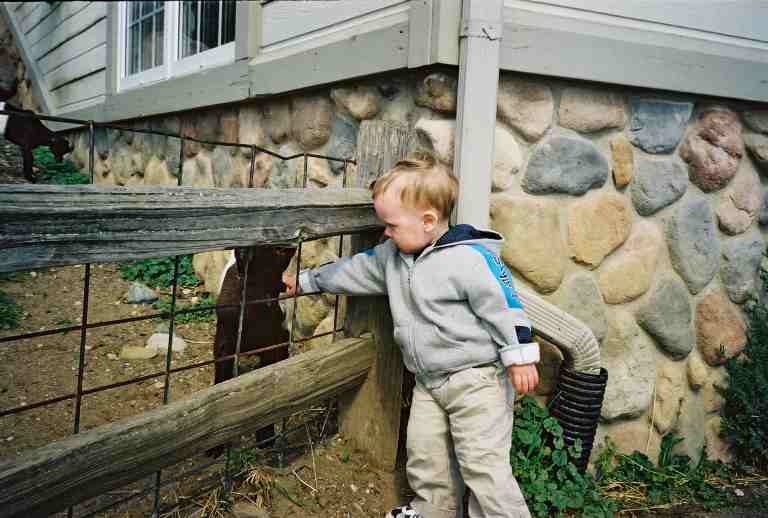
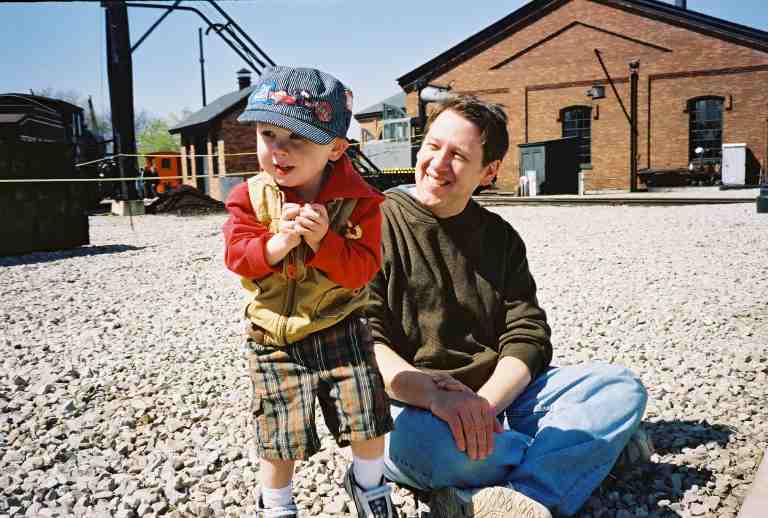

Friday, July 07, 2006
"Where's the Liquor!"
I'm battling a slight hangover today, subsisting on Snapple and buttered toast. Ron and I spent last night guzzling margaritas on our deck with friends Amy and Jason, visiting from out of town.
The drinks were my fault, of course, the result of a brainstorm in Target's summer clearance aisle Thursday morning. I picked up some $2 margarita glasses while Benny snagged a plastic martini shaker with a big blue parrot on it.
Then we headed to the supermarket for some tequila, where I cruised the beer aisle with mounting irritation.
"Where's your liquor?" I asked a grocery clerk. He looked at me warily, as well he might: a wild-eyed woman in a wrinkled shirt, followed by a tiny toddler clutching a martini shaker. They didn't have any liquor, of course, and I trudged over to the drugstore and bought my hooch there while the cherry cheesecake melted in the car.
But all was ready when Amy and Jason arrived (and Ron) and we headed out to eat. Benny was as naughty as naughty could be in the restaurant: whining, pouting, refusing to eat, demanding snacks and stickers and aspirin (wait, the last was for me).
Disgusted, I left the restaurant and marched Benny back to the car, where I stuffed my howling son into his carseat ("Benjamin Andrew, you are going home and to BED!") Then I slumped behind the steering wheel and glared resentfully at happy, childless couples strolling by.
Ron turned up with our friends and negotiated Benny's release so we could walk around downtown too. Then we returned to the house, where I rushed to the freezer and was pouring margaritas before Amy could take off her jacket. Benny received a glass of ice water with a plastic martini stirrer. (Yeah, I know.)
Benny went to bed at 8 p.m., shrieking with outrage. Then he was up at 5:17 a.m. ready for the day. I felt slightly nauseous; Ron had a headache from the tequila. I brought Benny to our bed, but that never works -- he just flops around and giggles.
Finally Benny slid off the bed and picked my socks off the floor. He held them up to me and asked "Mommy, wake up?" I admitted defeat.
Today I'm taking Benny to my sister's for five days. Halleluiah.
##
The drinks were my fault, of course, the result of a brainstorm in Target's summer clearance aisle Thursday morning. I picked up some $2 margarita glasses while Benny snagged a plastic martini shaker with a big blue parrot on it.
Then we headed to the supermarket for some tequila, where I cruised the beer aisle with mounting irritation.
"Where's your liquor?" I asked a grocery clerk. He looked at me warily, as well he might: a wild-eyed woman in a wrinkled shirt, followed by a tiny toddler clutching a martini shaker. They didn't have any liquor, of course, and I trudged over to the drugstore and bought my hooch there while the cherry cheesecake melted in the car.
But all was ready when Amy and Jason arrived (and Ron) and we headed out to eat. Benny was as naughty as naughty could be in the restaurant: whining, pouting, refusing to eat, demanding snacks and stickers and aspirin (wait, the last was for me).
Disgusted, I left the restaurant and marched Benny back to the car, where I stuffed my howling son into his carseat ("Benjamin Andrew, you are going home and to BED!") Then I slumped behind the steering wheel and glared resentfully at happy, childless couples strolling by.
Ron turned up with our friends and negotiated Benny's release so we could walk around downtown too. Then we returned to the house, where I rushed to the freezer and was pouring margaritas before Amy could take off her jacket. Benny received a glass of ice water with a plastic martini stirrer. (Yeah, I know.)
Benny went to bed at 8 p.m., shrieking with outrage. Then he was up at 5:17 a.m. ready for the day. I felt slightly nauseous; Ron had a headache from the tequila. I brought Benny to our bed, but that never works -- he just flops around and giggles.
Finally Benny slid off the bed and picked my socks off the floor. He held them up to me and asked "Mommy, wake up?" I admitted defeat.
Today I'm taking Benny to my sister's for five days. Halleluiah.
##
Wednesday, July 05, 2006
Enron's Kenneth Lay
Lay's obit in Wired
Good heavens, Kenneth Lay of Enron just died of a massive heart attack. I remember when I was living in San Francisco in 2000 and reading about Enron's spectacular success. The company was no. 7 on the Fortune 500, for crying out loud, with over $100 billion in annual revenue.
That seems like a lifetime ago, those days when I worked at AllBusiness.com, rented my movies from Kozmo.com and ordered groceries from Webvan.com. Now all three companies are extinct, reminding me of piezophilic bacteria, those weird little microbes living in impossible conditions.
(And yes, I had to look up the name. Now that I have, perhaps I can work the term “piezophilic” into casual conversations:
“Gee, Ron, you’re acting positively piezophilic today. Maybe you should go find your laptop and work some more.”
“That kid is totally piezophilic. If he doesn’t get his peanut butter crackers at precisely 2:30 p.m., he falls apart.”
Hmmm … maybe not.)
Anyway, piezophiles live in extreme, high-pressure environments like the bottom of the Marianas Trench. These guys love such absolutely insane conditions that some scientists think they’d survive on Jupiter’s moon Europa.
more on these weirdos
But bring a piezophile up to the surface, with all that nice air and light, and zap – it’s dead. Bring an exquisitely calibrated dot-com out of the 90’s high-pressure frenzy and it pops.
(Or in the case of Webvan, slumps with the soft hiss of leaking air. For years, only the green cupholders at Pacific Bell Park remained.)
So now we have Kenneth Lay, disgraced, convicted, unable to justify buying a $100,000 yacht while Enron was going under. And he’s gone, a victim of too much light and air. How piezophilic.
Good heavens, Kenneth Lay of Enron just died of a massive heart attack. I remember when I was living in San Francisco in 2000 and reading about Enron's spectacular success. The company was no. 7 on the Fortune 500, for crying out loud, with over $100 billion in annual revenue.
That seems like a lifetime ago, those days when I worked at AllBusiness.com, rented my movies from Kozmo.com and ordered groceries from Webvan.com. Now all three companies are extinct, reminding me of piezophilic bacteria, those weird little microbes living in impossible conditions.
(And yes, I had to look up the name. Now that I have, perhaps I can work the term “piezophilic” into casual conversations:
“Gee, Ron, you’re acting positively piezophilic today. Maybe you should go find your laptop and work some more.”
“That kid is totally piezophilic. If he doesn’t get his peanut butter crackers at precisely 2:30 p.m., he falls apart.”
Hmmm … maybe not.)
Anyway, piezophiles live in extreme, high-pressure environments like the bottom of the Marianas Trench. These guys love such absolutely insane conditions that some scientists think they’d survive on Jupiter’s moon Europa.
more on these weirdos
But bring a piezophile up to the surface, with all that nice air and light, and zap – it’s dead. Bring an exquisitely calibrated dot-com out of the 90’s high-pressure frenzy and it pops.
(Or in the case of Webvan, slumps with the soft hiss of leaking air. For years, only the green cupholders at Pacific Bell Park remained.)
So now we have Kenneth Lay, disgraced, convicted, unable to justify buying a $100,000 yacht while Enron was going under. And he’s gone, a victim of too much light and air. How piezophilic.
Subscribe to:
Posts (Atom)