
Sunday, August 31, 2014

Wednesday, August 27, 2014
Burn, Baby, Burn

That’s the only logical conclusion I can draw from the events of the past two weeks. I certainly didn’t plan to take my first step toward attending a counterculture art rave in the Nevada desert when I woke up Aug. 18. It was Benny’s first day of school, and my main concern was getting a spot to take his picture before the bell. Which I did, of course.
But my friends Andrea and Michael were there, and we fell to talking. Michael’s an artist who takes his amazing lighted sculptures all over the U.S. (including Grand Rapids, Mich. of all places) and Andrea does sound editing for motion pictures. Just standing near them made me cooler, so it was no surprise to hear them talking about Burning Man. They go every year as a family and their son Milo is one of Benny’s closest friends.
“You should go, too, you and Ron and Benny,” Andrea said.
“We don’t have tickets,” I said.
“You could get them on Craigslist.”
“Uh huh,” I said. I could just see myself getting mugged in the Castro by a drug-crazed lunatic pretending to be a drug-crazed lunatic with a Burning Man ticket.
It was intriguing, though. So I went home and scanned Craigslist, and yes, there were plenty of tickets, but the face-value ones were like day lilies, blooming and dying in minutes. So I gave up on my dreams of practicing radical self-expression on a dried-up lakebed and reorganized my kitchen cupboards.
Andrea, however, didn’t let it lie. She started emailing me tips for snagging a hot ticket, and when it became obvious I was ignoring them, she started casting for one herself. (By now Ron had made his total – and sensible – lack of interest known and I was looking for only one ticket. Benny was free.) I found myself time-stealing at work, reading articles about the event and staring agog at the pictures and vehicles. On Thursday, Aug. 21, I received the text – she found one, and bought it for me. The first and biggest hurdle was overcome. Benny and I were going to Burning Man in a week!
But I needed a vehicle pass. I quickly connected on Craigslist with a guy who lived just 15 minutes away. I picked Benny up from school and swung by and we met up at the corner by his apartment. Hurdle number two cleared!
By now Benny was catching on to the whole thing. “You need a bike, Mom,” he said.
Oh, crud. I didn’t have a bike. I didn’t want to ruin Ron’s nice bike in an alkaline desert, and anyway it was a road bike. I needed fat tires for the playa. So I emailed a bicycle shop in North Beach. The next morning Ron and I turned up before work, and there was the perfect mountain bike, a “burner bike,” for $120. Then we needed a bike rack, so the next day we went to REI, which of course was having a sale, and picked up one of those crazy racks you stick on the back of the car.
So obviously a Higher Power Has Spoken: “And thus shall ye attend the bacchanalia and spend thy days wiping desert dust off ye child.”
That’s not to say the course to this reckless enterprise has run entirely smooth. I haven’t slept well in days. The bike rack turned out to be an enormous pain to install. (The instructions said it wouldn’t fit a Honda Fit, but the Internet said no, it won’t fit a Honda Fit Sport, and then we had to figure out the measurement between the rivets, and so on …) The list of provisions I needed to pack grew longer and longer and longer, and Andrea just wanted to know what costumes I was bringing.
Costumes? I’m over here pricing ski goggles and getting Benny’s sleeping bag repaired and she wants to know about my kick-ass wig and sequined halter top. My wardrobe tends toward the Boring Mom About Town side of style, and I was simply going to have to radically participate in the community wearing my khakis. Anyway, I needed provisions. I printed out a list and took it to Target, brought it all home and took everything out of its original packaging (“Leave No Trace!”). Then I wrote down everything I forgot and snuck out of work yesterday to finish my shopping at the hardware store (mask, propane tank) and Walgreens. I also talked to my brother Greg, who recently returned from his Army deployment in Kuwait. He thinks I’m crazy, but gave me good advice about surviving desert environments.
Now almost everything is tucked into baggies and stuffed inside plastic boxes. Ron has put the tent and other camping equipment in the car. The ticket and vehicle pass are displayed in the mirror by the front door. Benny and I leave Thursday at noon, where the plan is to spend the night in Reno and arrive at Black Rock City Friday morning.
So why am I doing this, might you ask? I’m not entirely sure. Does anybody really know why they do anything? As far as I can tell, people go to Burning Man for their own reasons, reasons they themselves may not understand. For some it’s the drugs, for some it’s the sex, for some it’s the art, for some it’s the feeling of belonging in a world that feels less than welcoming. For some it’s the friends they bring. For some it’s an escape. My guess I won’t know why I’m going to Burning Man until after I’ve returned. In the meantime, I’ve got this black and silver dress from a past Halloween, perfect for dancing at the Burn. It’s a sign.
Monday, August 18, 2014
First Day of 5th Grade
 |
| First day of 5th grade. |
 |
| First day of kindergarten. |
 |
| Gotcha! |
Benny's last year of elementary school starts today, and I want to enjoy it -- volunteer more, attend more events, bake more cupcakes and generally milk this year for all it's worth. I've even changed my work schedule so I no longer work Mondays. Who knows how much longer he'll want me around?
Monday, July 07, 2014
Our Lake Michigan Circle Tour
Lake Michigan is a big lake. It covers 22,300 square miles and is the 5th-largest lake in the world. (If you count the Caspian Sea as the world's largest lake. Geologist say it's actually a tiny ocean.)
Two years ago Benny and I crossed the lake by ferry; this year the whole family drove around it, from Chicago to Milwaukee and then to Post Lake, Wisc. From there we entered Michigan through the back door: Tahquamenon Falls, Whitefish Point, Copemish and South Haven. Then we dashed south to Indianapolis and back, and Benny and I spent another week in Michigan before driving back to Chicago.
Here's a map of the trip.
Thank you so much to the relatives who provided free room and board: Mike and Diane, Marlene and Ron, Mom and Paul, and especially Cindy and Scott, who hosted us for two weeks. Benny loves the Midwest ("It's so open here!")
I covered our trip extensively on Facebook (perhaps over-extensively) with phone pictures. Here are some shots from my camera, which I just downloaded to my laptop last night.
 Our first tourist attraction was Tahquamenon Falls, mentioned in Longfellow's poem Hiawatha. I never could read that poem all the way through, but I do remember the part about the wind god falling in love with a dandelion* and who can forget the lovely Minnehaha?

We drove south over the Mackinac Bridge (pronounced Mack-in-aw) into Mackinac City, where we gorged on fudge, ice cream and popcorn. As we drove over the bridge, I couldn't help thinking of the poor Yugo driver who was blown off the bridge years ago in high winds. Weird. I drive over the Bay Bridge and the Golden Gate Bridge all the time and never worry about that.

In South Haven we saw my college roommate Jackie, her husband Doug, and Caitlin, Josh, Kyle and Alyssa. Jackie hasn't changed a bit since college, which frankly, is hard to forgive.


Mom and Paul took us to the Children's Museum in Indianapolis, which had eight priceless Chinese terracotta warriors on display.


Back in South Haven, we attended Harbor Fest and watched the dragon boat races.

Then it was back to the beach with college roommates Kris and Jackie and their families at Oval Beach in Saugatuck.

After nearly a month away, it was strange to be in San Francisco again, but the city gave us a warm welcome with one more beach day.
We plan to return to the Midwest next summer to celebrate three high school graduations. We can't wait!
-------------------
* The word "dandelion," I happened to learn today, comes from late Middle English: from French dent-de-lion, translation of medieval Latin dens leonis‘lion's tooth’ (because of the jagged shape of the leaves). This factoid comes courtesy of my newspaper coworker who puts little quotes on the bottom of his emails.
Two years ago Benny and I crossed the lake by ferry; this year the whole family drove around it, from Chicago to Milwaukee and then to Post Lake, Wisc. From there we entered Michigan through the back door: Tahquamenon Falls, Whitefish Point, Copemish and South Haven. Then we dashed south to Indianapolis and back, and Benny and I spent another week in Michigan before driving back to Chicago.
Here's a map of the trip.
Thank you so much to the relatives who provided free room and board: Mike and Diane, Marlene and Ron, Mom and Paul, and especially Cindy and Scott, who hosted us for two weeks. Benny loves the Midwest ("It's so open here!")
I covered our trip extensively on Facebook (perhaps over-extensively) with phone pictures. Here are some shots from my camera, which I just downloaded to my laptop last night.
Our first tourist attraction was Tahquamenon Falls, mentioned in Longfellow's poem Hiawatha. I never could read that poem all the way through, but I do remember the part about the wind god falling in love with a dandelion* and who can forget the lovely Minnehaha?We drove south over the Mackinac Bridge (pronounced Mack-in-aw) into Mackinac City, where we gorged on fudge, ice cream and popcorn. As we drove over the bridge, I couldn't help thinking of the poor Yugo driver who was blown off the bridge years ago in high winds. Weird. I drive over the Bay Bridge and the Golden Gate Bridge all the time and never worry about that.
In South Haven we saw my college roommate Jackie, her husband Doug, and Caitlin, Josh, Kyle and Alyssa. Jackie hasn't changed a bit since college, which frankly, is hard to forgive.
Mom and Paul took us to the Children's Museum in Indianapolis, which had eight priceless Chinese terracotta warriors on display.
 |
| Oh no! A dinosaur is chasing Benny! |
Back in South Haven, we attended Harbor Fest and watched the dragon boat races.
Then it was back to the beach with college roommates Kris and Jackie and their families at Oval Beach in Saugatuck.
After nearly a month away, it was strange to be in San Francisco again, but the city gave us a warm welcome with one more beach day.
 |
| Benny and his friend Griffin at Ocean Beach. |
We plan to return to the Midwest next summer to celebrate three high school graduations. We can't wait!
-------------------
* The word "dandelion," I happened to learn today, comes from late Middle English: from French dent-de-lion, translation of medieval Latin dens leonis‘lion's tooth’ (because of the jagged shape of the leaves). This factoid comes courtesy of my newspaper coworker who puts little quotes on the bottom of his emails.
Saturday, October 05, 2013
Meet Mr. Economy
So when I was in Seattle pitching my memoir to agents, I
made all kinds of blithe promises, including “I use the economy as a character
in my story.” Now that I’m preparing materials for agents, I’m all “Holy crap,
I have to use the economy as a character in my story. Who the hell does that?”
That meant I actually had to think about what kind of
character the economy — specifically the economy of March 2007-March 2008)
would be. Would Lord Economy be like Sauron, a dark, malevolent shadow over the
landscape, occasionally sending out the Nazgul of Foreclosure or the Witch-King
of Mortgage Derivatives? Or would we have Miss Economy, like the Queen in
Narnia, who cast a spell over our happy land, forcing up oil prices and credit
card rates? I was tempted to create an Economy God, a reckless, vengeful
Poseidon whipping up economic storms to prevent our hero from reaching a safe
harbor. But not even I was paranoid enough to consider myself an Odysseus,
unjustly persecuted with hidden bank fees.
 In the end, I settled
on Mr. Economy, a mighty, well-meaning, but none-too-bright giant. In March
2007, our Mr. Economy was strong and confident, almost too confident. He was
reckless, shrugging off any restraint, running faster and faster. He was a
gambler, hopped up on easy money, greedily gobbling up debt instruments. The
sun is warm, the grass is soft and it never enters his pea-brained mind that things
could ever change.
He looked so strong then, but of course that strength was
illusory. Real strength comes through discipline and training and experience.
Truly strong characters develop sound judgment and act purposefully, willing to
practice moderation and prepared for setbacks.
In March 2007, Mr. Economy was a happy camper, with
corporate earnings growing big. He notices
a small pain in the housing market (foreclosures up, home sales down) but pays
it no mind.
In June, he notices another pain, the investment banks, who
suddenly are worried about their sketchy, risky investments.
But in July, he still feels great. Everything’s fine, the
Dow hits 14,000 for the first time.
In August, Mr. Economy starts feeling sick to his stomach.
He’s been gobbling up all this shifty debt and he’s having trouble digesting
it. He behaves erratically, up one day and down the next.
In September, he’s getting some headaches from housing,
retail and financial industries. But he won’t listen to the Federal Reserve
asking him to pretty please be responsible with the foreclosures. He’s starting
to bleed jobs.
October brings a high fever, and of course, hallucinations.
Everything’s rosy! Dow hits record high of 14,087! The worst is over! But
infection has set in.
In November, our Mr. Economy is feeling really bad. Banks
are hammered, everyone says recession is coming.
By December, Mr. Economy is breaking down before our very
eyes. One million U.S. homes are in foreclosure. Our giant falls to his knees —
he’s tapped out and can’t run any more.
In January 2008 he’s crawling along. Oil is at $100 a barrel, the
Dow is weakening. The Fed slashes interest rates, but even with mass
transfusions of money, Mr. Economy hasn’t felt this bad since 1974.
By February the vultures are circling. Credit card lenders
jack up rates and fees on consumers and inflation rises.
In March, Mr. Economy is hardly moving, crushing consumers
beneath him. He now has a choice: will he take his nasty-tasting medicine and
get stronger faster, or will be just lie there, still crushing consumers and
hoping he’ll slowly get stronger?
The answer, of course, is that the Fed doesn’t administer
strong medicine, like allowing big financial institutions to fail and imposing new
regulation. Instead, the Fed and the government administered massive
transfusions of taxpayer dollars and a few weak restraints and called it a day.
Which is likely why, although officially this recession ended in 2009, the
recovery has been weak and why a wounded Mr. Economy continues to limp along, no matter what the stock market says.
Thursday, September 05, 2013
Better Living Through Dorkiness

So apparently Benny needs to know all the U.S. states and capitols by Sept. 13. Actually, the entire fourth grade needs to know their states and capitols. The school's really serious about this; we parents had to sign a little form saying we would help our children learn this lesson and not allow them to sink into state-and-capitol-less despair.
The form even had fine print, which I didn't really read but might say that if Benny fails, Social Services will turn up and place him with a new family that knows the capitol of Connecticut is Dover. I mean Frankfort. Hartford?
I realized tonight, as Benny and I were eating dinner, that I had a captive audience here and could address this topic in my own dorky way. So I started reading off states in alphabetical order: if Benny guessed the capitol, great. If not, then I would tell him not only the name of the capitol, but how the city got that name, on the theory that knowing the history behind the name would help him remember it. Well, I don't know if it works, but it was a fun way to learn new facts while listening to Benny moan every time I said, "Okay, let's look it up!"
After a while I didn't want to stop and that's how I learned about the following state capitols:
 |
| A piece of the Little Rock at the Arkansas capitol. |
named after a little rock on the river that was a navigation aid for boats.
Hartford, Connecticut
named after Hertford, England, but pronounced Hartford.
Tallahassee, Florida
Indian name for "old fields" because earlier Indians had cleared a bunch of land already.
Atlanta, Georgia
I thought it was after the woman with the golden apples in Greek mythology. Actually, it was named by a railroad guy who called it Atlantica-Pacifica and it was shortened to Atlanta.
Des Moines, Iowa
Named after the Riviera Des Moines or "River of the Monks" in French, but I don't know what the monks had to do with anything.
Baton Rouge, Louisiana
French for red staff or stick, maybe after the big cypress tree on the site
I end with Lansing, Michigan, our home state.
Lansing was originally some lame little settlement named after some guys' hometown in New York State. But in 1847 the state leaders wanted to move the capital further into the interior away from hostile British Canada, which had taken Detroit in the War of 1812. Michigan's other big cities vied for the honor, but they chose some flyspeck village with 20 people.
Stay tuned for more dorkiness tomorrow!
Sunday, August 25, 2013
How I Started Chapter Five by Freaking Out
I need to write Chapter 5: Recessions I Have Known, but I'm scared. I’ve done everything
but write in the last 40 minutes. I’ve posted on Facebook, changed my Apple
password, bought a Seal album, helped Benny create a birthday card. And now I'm at my desk again. It's scary.
Who does stuff like this? Who sets their lives against the economy, who strings together the
major events of their lives using recessions like fat beads on a string that winds
and knots? I’m going to tangle this up.
I’m feeling some pressure. I want to
send this out in September. Chapter Five was supposed to be a light revision and now it's a whole new chapter, possibly one of the most important chapters in the book.
 |
| The god Pan. |
I'm in a panic.
Panic: a a sudden sensation of fear so strong as to dominate or prevent
reason, replacing it with anxiety. A Greek word from the shepherd god Pan, who liked to frighten goats
and sheep.
 |
| The frying Pan. |
It’s also an old-fashioned word for a financial crisis, like the
panics of 1857, 1873 and 1907. All triggered by worries over gold, silver or copper. Panic. All the goats and sheep scattered.
I'm trying to write about the 1973-75 recession. But it wasn't a recession, it was a Panic.
Yay! I'm on my way! An hour later, I'm still typing madly.
There's got to be an easier way to do this.
Friday, August 16, 2013
Puzzle Pieces

We ask "How did you sleep?" "How was your commute?" "How was your weekend?"
Then later, "How was your day?"
What do we answer? We say what we think they want to hear, what we're willing to share, the highlights, but we don't truly answer. We all have secrets. Some of us have big secrets. Some of us have a secret so big that we carry it around all day, touching it lightly with our fingertips to remind ourselves that it's really there.
My own secrets are becoming a little problematic because I'm writing about my life. I'm writing a memoir about a year in my life and I'm skimming over some sticky parts. This is fundamentally dishonest. It may weaken the writing. So when I finish the first 75 pages and they are all polished and prettified and sent out and I can start writing rough again, I will tell all my secrets, get them out on the page. I don't have to show them to anybody.
Right now I'm telling myself that many personal details don't matter in this memoir, that this memoir is about the financial life and this might be true. Or it might be a cop out. The only way to find out is to let all the secrets out. Maybe I'll have to include some and hurt people. There's only one way to find out.
At any rate, I can't keep censoring myself. If I keep doing that, than the final picture of my life will be alike a puzzle with missing pieces, gaping holes where meaning is missing.
I am all the puzzle pieces. My life is all the puzzle pieces. Write every puzzle piece, no matter how ugly or awkward the shape. If you don't, then you won't have a prettier picture. You'll just have a picture with an awkward, ugly hole.
Sunday, August 11, 2013
PNWA: The risky businesses of journalism and publishing
 |
| Beaten and battered, but still fighting. |
Journalism and publishing are two very different industries, and the differences go far beyond the whole double-spacing-after-a-period thing.
Journalists work in a fast-paced environment and our jargon reflects this: scoops, headlines, cutlines, pull quotes, banners, leads (or leads), deadlines ... see all those verbs? We scoop, we cut, we pull, we lead and then we drop dead.
If journalism’s time reference is quick and human, publishing’s time frame is more … geologic. An epoch can give way to an era between a book’s conception and publication. At last month’s Pacific Northwest Writers Association’s conference, we were “authors” not “reporters” who wrote “manuscripts” not “copy” to be “published” not “printed.” The jargon was more sedate: advance, slush, pitch, royalty, galley.
But despite these differences, the two industries face similar challenges these days, a clash between the old and the new, as traditional professionals fight to be heard above online newcomers. In journalism, these newcomers are called bloggers or “citizen journalists,” the latter embraced by online newspapers as a cheaper, faster way to get content. In publishing, those new guys and gals are self-published authors.
In traditional journalism not so long ago, a story was pitched to an editor, the editor followed up on the story’s progress, the story was submitted and edited, then copy edited, then proofed. Then and only then did the story go public. Errors and typos still slipped through, but the process worked to create the most professional result possible. Ideally, the finished result would be a professionally produced work, the product of a group collaboration, not one single mind, no matter how talented.
Similarly in publishing, for a book to hit the shelves, the writer pitches an agent who sells the project to a publisher. A whole table of people vet this acquisition: editors, marketers, production staff, publicists … they all have to sign off on it. Again, the final product, while not perfect, is professionally produced, the result of a group of talented minds.
Furthermore, both journalists and book writers have a formal apprenticeship, years of writing before you get the plum assignments or the book contracts.
The Internet has changed all this, of course. Now traditional newspaper writers compete with bloggers and “citizen journalists.” Traditional book authors compete with self-published authors. These nontraditional writers often display great creativity and talent and are formidable competitors not to be underestimated.
But with the barriers to entry in both industries partly dismantled, readers are flooded with books and articles in various stages of professional development. It can be difficult for readers to distinguish between a professionally sourced news story and an amateur blog post. Book readers surfing on Amazon’s wave of titles may lump together the professionally agented, edited, marketed and designed books and their self-published counterparts.
At the PNWA conference, I repeatedly heard speakers say today’s books have to “break through the noise.” I hear this phrase in online journalism too. So the question for both journalists and book writers becomes, how do we uphold the traditional standards of our industry while still innovating and accepting change?
One thing is for sure, looking down our noses at self-published authors and citizen journalists may make us feel better but won’t help anyone. My newspaper recently wrote about San Francisco International Airport’s crackdown on those newfangled ridesharing companies. In an effort to protect the taxi drivers who take passengers to and from the airport, SFO has conducted citizen’s arrests of Lyft and Uber drivers for trespassing.
Well, as a taxi passenger who has waited an hour for a taxi, endured baffling, circuitous routes to my destination or has had to scrape up cash because the taxi driver’s credit card reader was mysteriously broken, I say the traditional taxi industry in San Francisco has left a gaping customer service hole large enough to drive a gleaming, black Uber car through. Ridesharing companies are filling a need, or they wouldn’t be so successful, and taxi companies ignore this at their peril.
Traditional journalists and book writers can’t be like those taxi drivers. We can’t close ranks against the newcomers. They are now part of our culture and our dialogue. I believe in traditional publishing; I choose to prepare my memoir for agents. But I believe in self-publishing too, although it is not for me.
There is one word I don’t hear much of in either the journalism or publishing industries, probably because it was so self-evident. That word is “risk.” My newspaper is currently making enormous changes and taking huge risks. Publishers take big risks every time they acquire a book.
Bloggers, citizen journalists and self-published authors are considered the risk takers these days. But as bookstores and newspaper stands close every day while my own articles and book manuscript inch along the longer path to readers, today’s traditional journalists and book authors remain the biggest risk takers of all.
Thursday, August 01, 2013
PNWA Conference: Christine's tips
Well, I'm back from the Pacific Northwest Writers Association conference in Seattle. I've been to exactly one writer's conference now in my adult life, so of course that makes me an expert.
So here are Christine's Top 10 Tips to a Successful Writing Conference:
1. Fly in the night before the event begins.
Everybody is boring the first two hours after they get off the plane. I could immediately spot the folks who flew in Thursday morning, staggering around all haggard in wrinkled clothes. I met a nice man that day with an undoubtedly fascinating novel, but he'll forever live in my mind as "The Guy Who Spent 40 Minutes on the Tarmac."
2. Want to make friends? Drop your registration packet while standing in line for pitch session registration. With any luck, you'll scatter the detritus at the feet of the host organization's president. It worked for me, although I lost two pens and an event ticket.
3. Don't wear a bright color or a vivid pattern on the first day. I met a woman who's writing a paranormal romance with pirates. Unfortunately, she was wearing a lurid orange shirt on the first day and I never caught her name or memorized her features. I never found her again.
4. For the love of God, figure out what to do with your business cards. First I had a special pocket, then I tried a special baggie, then I wrapped a rubber band around them. Finally I used my brain and stuffed a bunch into my name badge — problem solved. Then I could look on smugly while new friends ransacked their pockets and bags looking for cards to give me.
5. Linger after sessions. This is how I nabbed three of the four agents I pitched before my official pitching session. It's slightly more dignified than pouncing on agents on the elevator or in the bar. Plus you get to eavesdrop on the people in line in front of you.
6. This is a trick from my days covering board meetings as a reporter:
Draw a little map of panel participants first thing. That way, when the Question and Answer starts, you know who said what.
7. Never abandon a muffin to get to a session on time. You’ll end up surreptitiously crunching peanut M&Ms from the bottom of your purse at 8 in the morning just to survive the 90-minute session. Crinkly candy wrappers can be very loud in a hushed conference room.
8. Crash different genres at the Writer’s Café, where there’s a Memoir table, a Romance table, a Literary Fiction table, etc. I always like to know what’s going on in the galaxy at the Science Fiction table. Gene manipulation and artificial intelligence are apparently very hot this year.
9. The plot of your book should be a closely guarded secret. Plots take forever to spin out, and pretty soon people’s eyes start glazing over. If you start describing the climax of your book, and a certain person named Christine goes off to get another drink and look at the appetizer menu and she gets back and you’re still in the climax, it’s time to tighten up your book pitch.
10. If an agent you’ve pitched says “Fine, send me something” or better yet, gives you his or her card, this is your cue to disappear. I’d read this advice already from the fabulous Anne Mini, but that didn’t stop me from babbling some more to the first agent I pitched. Some people just can’t take yes for an answer!
Saturday, July 06, 2013
Pretty Nervous Writing Aardvarks Speak Out!
Now that I'm back from Europe and life has settle down somewhat, it's time to think about my next trip: The PNWA Writers Conference in Seattle on July 25-28. That unpronounceable acronym, by the way, stands for the Pacific Northwest Writers Association. I call them the Pretty Nervous Writing Aardvarks so I can keep the letters in the right order.
I hadn't planned to attend the conference; it seemed like an indulgence so soon after Europe. But on Memorial Day I received a call from the Writing Aardvarks: My unfinished memoir, Too Small to Succeed, is a finalist in the Nonfiction/Memoir category. The PNWA lady (I was so amazed I now can't remember her name or hardly any other word in the phone conversation other than "finalist") asked me if I was attending the conference in July. Well, I am now, I wanted to stay, but mustered my manners and said I would very much like to attend.
So now I'm going, and I haven't been to a writing conference since I was 10, when I won a school writing contest with a poem about World War II. It went like this:
That crazy Hitler, he started a war,
and I have no doubt that there will be more.
They won't be by him, because he is dead,
but from my point of view he had rocks in his head.
The poem went on for pages, I'm sorry to say, and my mother actually sent me a copy recently. Well, Benny liked it, anyway.
Anyway, this means that Too Small to Succeed is no longer just a Weird Little Project on the Side. I wrote the first two chapters in 2010 and then dropped it for two years, picking it up again last year. I kept working on it even after rejoining the Business Times in January and it's passed the 30,000-word mark now.
To help things along last summer, I joined a local memoir group. You know you're in a heavy crowd when your recession memoir tracing the country's financial collapse is the most lighthearted of the group. The other writers' topics ranged from sex cults to the Holocaust, much to the disturbance of other patrons at the Berkeley cafe where we met. The memoir group's leader ran a tight ship, necessitating a constant stream of emails and long phone calls about my writing purpose after I missed a few meetings.
So I ditched the memoir group, but I still needed feedback, so I entered the memoir's first 27 pages in the Writing Aardvark's literary contest, lured by the promise of detailed critiques from two judges.
Be careful what you wish for, for now my finalist status, the critiques and my preparations for the conference are making me self-conscious. Yesterday I read my 11 chapters for the first time in over a month, and while they hold up all right, writing new stuff has been difficult. I spent six hours writing yesterday, muttering at my laptop while Benny watched Sponge Bob and read his Percy Jackson books, hoping that eventually I'd produce something that wasn't terrible.
The results are not great: Chapter 12 is about September 2007, a month full of adjustments to our new apartment, my new editing job and Benny's new preschool, not to mention a horrifying pile of bills that added up to more than Ron's monthly take-home pay. Shiver. Throw in a Sept. 17 deadline to write 24 Latino Business Awards profiles in my spare time and this chapter makes me want to crawl under the dining room table with the cat. Not so funny. I'm having difficulty maintaining the amused detachment of earlier chapters. That humorous tone the judges liked so much is nowhere in evidence in Chapter 12, so now I must decide whether I've lost my voice or whether the story has simply shifted in a new direction.
This, of course, has happened before and as Stephen King says, sometimes writing feels like you're just shoveling shit from a sitting position. You just have to have faith that something good is buried in there, and if there isn't, that what you're shoveling will eventually lead to something good. In times like these, any encouragement helps and so thank you again, Pretty Nervous Writing Aardvarks.
Tuesday, June 18, 2013
Denny and Me
 |
| Basilica Saint-Denis. |
I took the subway nearly to the end of the ride, about 20 minutes and popped out on a sunny square. No tourist hordes here; Saint-Denis was off the beaten path, even if nearly all the French kings and queens are buried here.
 |
| The Last Judgment Portal at Basilica Saint-Denis. |
 |
| Basilica's interior. |

 |
| Sunlight through the stained-glass windows cast colors on the floor. |
 |
| Charles V (in wig), Queen Jeanne (with crown) lying with other French royalty. |
During the Crusades and in medieval times French royalty would dither for years over where to be buried and would often write complicated wills commanding that their heart be buried in one place, their heart in another and the rest of the body in a third. Even the Pope's objection to cutting a body up couldn't make them stop until it finally fell out of fashion.
 |
| Childebert I. |
 |
| More royalty, including Pepin the Short and Louis III. |
 |
| King Henri and Catherine D'Medici. |
 |
| Louis XVI and Marie Antoinette. |
 |
The heart of little Louis XVII.
|
Saint-Denis was my last sight on this European trip and I lingered, not wanting it to end. I thought of returning to the apartment and helping Ron and Benny pack up our big backpacks again. I didn't want to fly back to San Francisco. I wanted to take the Metro to the Gare du Nord and catch the next train to Prague the next day. Ahead of us was a 20-hour day full of security lines and flight delays and officials digging through my backpack only to find that the threatening object inside was Benny's six-inch tall Big Ben figurine. The Brits apparently didn't trust the French and required an additional security check before they'd let us transfer to another plane, and the airline kept the gate number for the flight to San Francisco a state secret until 15 minutes after it opened. But our flight landed nearly on time and we were the first through customs.
"Two weeks?" the customs officer repeated. "And that's all your luggage?"
"Yup," we said proudly.
But that was all ahead of me. I had a glass of wine on the sunny square before the Basilica Saint-Denis, my bag on my lap and my head stuffed with medieval carvings and French history. It was time to go home, I thought. We were almost out of money, energy and clean socks. Next week Ron had a biotech panel, Benny had tennis camp and I needed to prepare for a writer's conference in Seattle. Au revoir, Europe.
Monday, June 17, 2013
Notre Dame, or Mary Goes to the DMV

Well, it's time for literally the mother of all Gothic cathedrals, Paris' Notre Dame. It's on the Ile de la Cite, the center of ancient Lutetium and medieval Paris. In 1160, the Bishop of Paris decided to build a new church to Mary using the new, cutting-edge Gothic style. Notre Dame is an early Gothic church, so it isn't as big and pointy and airy as the later cathedrals. (The Basilica of St. Denis, where French kings and queens are buried, is an even earlier Gothic, but we'll get to that later.)
You can see how solid and imposing the front is; it still feels a little Romanesque. Benny, Ron and I sat on bleachers in the sunny square while I read out loud about the facade. You've got a big rose window that looks like a halo on the Virgin and Child statue in the middle. Below that is a row of 28 kings of Judah, Mary and Jesus' ancestors.
 |
| Portal of the Last Judgment. |
The right portal featured Mary sitting in state like a queen, with a crown and sceptre and the baby Jesus. The left portal shows Mary's death, her ascension into heaven and her crowning as Queen of Heaven. Throughout this cathedral are numerous depictions of Mary's life, from birth to motherhood to death and ascension, over and over. I half expected carvings of Mary doing laundry, making dinner, going to the DMV, etc.
 |
| Little boats in the fountain at Luxembourg Gardens. |
 |
| An ominous cloud front over Paris. |
The next day we rose early and started the 20-minute walk to Notre Dame. The skies were ominous and as we crossed a bridge into the Isle de la Cite, the clouds burst open and it just poured. We arrived at the cathedral soaked to the skin and squishing with every step.

And so we had a dripping look around the Cathedral: the incredible nave and various statues of the Virgin and Child. Outside was a severe statue of Mary, stiff and Romanesque. The central statue is 19th-century, showing a new mother juggling a baby on her hip. Finally we have a romantic statue of Mary, all sweet and windblown with a cherubic Jesus.


Here's a shot of the high altar, and the modern bronze altar by Jean et Sebastien Touret, another example of how Europe incorporates modern art into its historic sites.


After a while we became tired of dripping water all over a priceless religious and historical site and left, sloshing through the downpour back to the Rue de Rivoli. We swam along the Rue de Louvre to the post office, where I mailed some sodden postcards and a package. (I forgot the word for air mail and hand to flap my arms to get my point across.)
Then we had a quick lunch and returned to the apartment. Ron and Benny were finished for the day — we were flying out of Charles de Gaulle the next morning and the apartment was just trashed. But then the sun came out and I thought there was time for one more medieval church. But that's a story for another post.
Friday, June 14, 2013
Biking in Versailles
 |
| Benny and I in front of the Grand Canal. |
Big day today, for today we go to Versailles. I woke up pretty jazzed at 5:30 a.m. and couldn’t go back to sleep. I was excited about leaving Paris for the day, excited about touring a sight I hadn’t seen before, and this wasn’t just a sight, it was Versailles, the extravagant palace of Louis XIV, the Sun King. Marie Antoinette and Louis VI lived there too, and were dragged from Versailles back to Paris by a mob during the French Revolution where they were later executed.
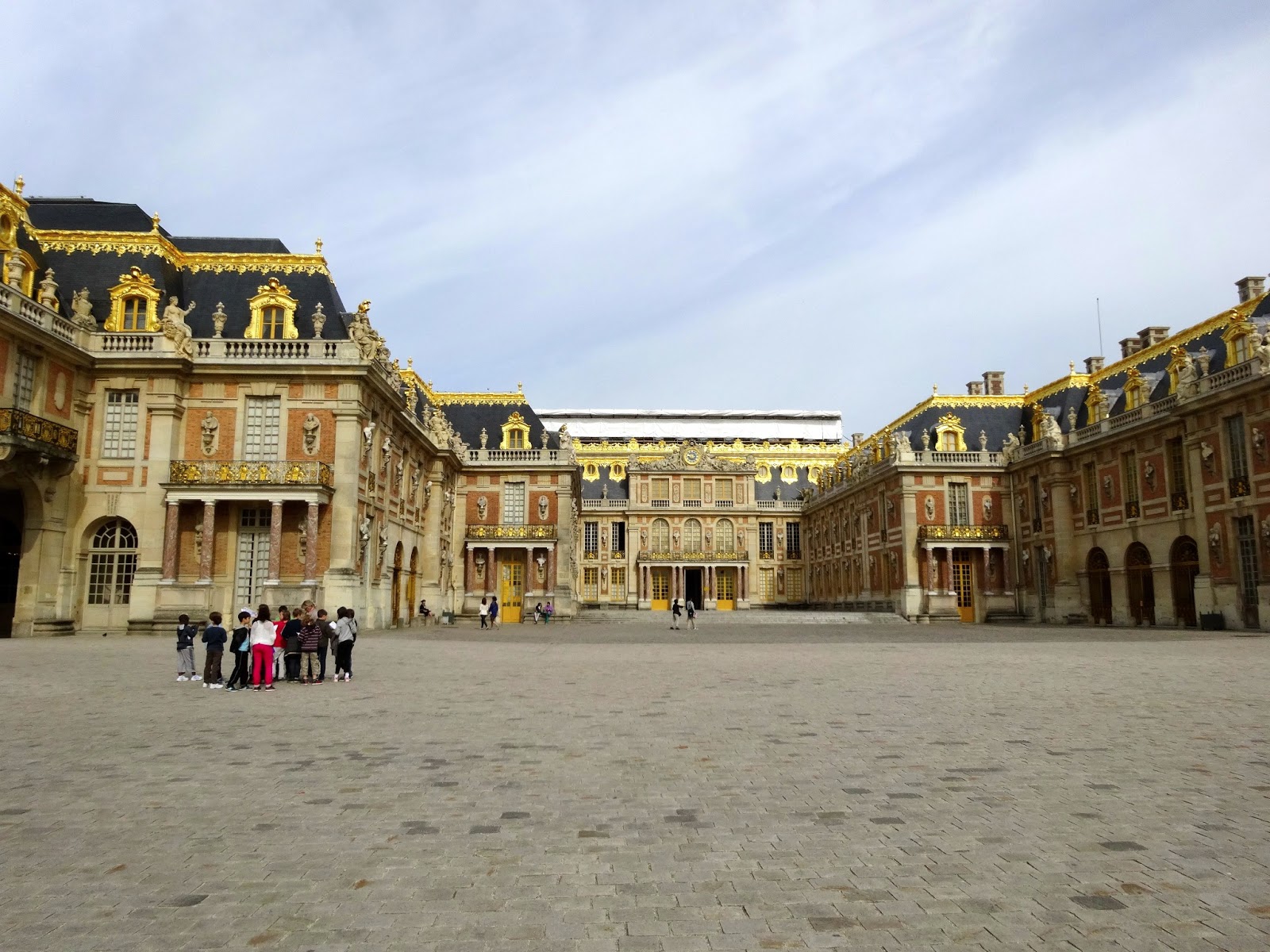
So I just couldn’t wait to see it for the first time, and prowled our tiny studio until it was time to wake Benny and wheedle him into dressing and eating breakfast. “No,” I repeated. “Versailles isn’t just a museum. We’ll get to ride bikes.”
Well, those were the magic words, because Benny perked right up and agreed to walk through the Tuilleries Gardens to the Seine, then cross the Pont Royal to the Museum d’Orsay. (“No Benny, we’re not going into this museum.”) The train station to Versailles, actually a suburban rail line — rather like BART for Paris — was in front of the Orsay.
The train was feeling kind of Muni that morning, though. A small crowd of tourists gathered, milling around, looking at the departure boards and trying to buy tickets. The station attendant at the one open ticket window announced there were computer problems, pulled the window shade down, walked away, and didn’t return. But I didn’t even consider giving up — our museum passes were only good for Friday and there was no way I was going to Versailles on a Saturday. Finally, after multiple tries, I managed to buy three tickets and we ran for the 8:34 train.
 |
| One of Italian artist Giuseppe Penone's tree sculptures in the Versailles gardens, created to blur the boundaries between nature and art. |
We were just in time — soon after we arrived, the line just exploded from a lazy little winding worm to a giant python, growing fatter by the minute, stretching out past the front gate. The only amusement was watching people come up the harried French museum guy at the head of the line. The scene was repeated endlessly:
Vistor: Where is the line for ticket holders?
Museum Guy: Zis iz the line.
V: No, for ticket holders.
MG: Zis! Zis iz the line!
V: (horrified) This line?
MG: Oui! This line!
Then the visitor would linger a bit, perhaps hoping the Museum Guy would change his mind, (“Mon Dieu! But of course, you can enter by this secret ticket-holder line!”) then trudge halfway to Paris to join the back of the line.

Benny had fun for a while identifying the various rooms: Ares, Hermes, Athena, Apollo, etc., but bikes were never far from his mind. We had audioguides this time and shuffled from treasure room to treasure room, simultaneously impressed and appalled. No wonder the French revolted.

Finally we took pity on Benny and headed outside. Ron and Benny sat in the sunshine while I bought souvenirs, then we walked through the gardens, eating lunch at a little outdoor cafe. We were a good half-hour ahead of the hordes, who were still gaping at Louie's bedroom, and the day was warm and sunny. We strolled over to the Neptune Gate to rent a bike, but alas! the bike rental booth was only open on weekends. Benny was devastated. "Let's go north," I suggested, thinking of the central square with a gift shop, restaurant and electric vehicle. "Maybe that bike booth is open."
Well, I felt like a hero when we got there, because the bike rental booth was doing brisk business, with waves of tourists wobbling off on their bikes, barely avoiding pedestrians. Benny's face when he saw the row of children's bikes was priceless.
I hadn't been on a bike in six years, so I did a little wobbling myself, but Ron wiped out first, hitting the dirt to avoid a car. For a time it looked like we'd have to leave the bikes and the garden and find a pharmacy. (The scrape was quite deep and bloody, and there were no first aid facilities at Versailles.) But Ron cleaned up the wound in the men's room and I wheedled a few bandages out of the nearby restaurant.
Then we headed off once more, taking two hours to circle the gardens and the Grand Canal. Benny was in heaven; the bike ride ranked right up there with the ferry trip, the Roman museum and the London Eye.

Finally we took pity on Benny and headed outside. Ron and Benny sat in the sunshine while I bought souvenirs, then we walked through the gardens, eating lunch at a little outdoor cafe. We were a good half-hour ahead of the hordes, who were still gaping at Louie's bedroom, and the day was warm and sunny. We strolled over to the Neptune Gate to rent a bike, but alas! the bike rental booth was only open on weekends. Benny was devastated. "Let's go north," I suggested, thinking of the central square with a gift shop, restaurant and electric vehicle. "Maybe that bike booth is open."
Well, I felt like a hero when we got there, because the bike rental booth was doing brisk business, with waves of tourists wobbling off on their bikes, barely avoiding pedestrians. Benny's face when he saw the row of children's bikes was priceless.
 |
| Apollo Fountain. |
Then we headed off once more, taking two hours to circle the gardens and the Grand Canal. Benny was in heaven; the bike ride ranked right up there with the ferry trip, the Roman museum and the London Eye.
Subscribe to:
Posts (Atom)